Showing posts with label Mozart. Show all posts
Sunday, July 16, 2017
Emperors and Bohemians
We went to Prague, and what a trip that was. I am quite sure there is no place like that Czech city on earth; Praha is a totally unique city--a surreal blend of medieval architecture and modern chutzpah.
One reason that ancient metropolis retains so much Old World ambience is that during the big war back in the '40's, Prague did not suffer major bombing damage. So there are parts of the city, particularly near the Castle, in which your wandering really does take on the feeling of a stroll through the Old Europe of medieval times, except for all the tourists waving their devices around.
Such as us.
We were right there, in with all that crowd of world-travelers snapping pics, gazing quizzily at our phones, searching for signs of meaning in the domiciles of Kafka and Havel.
Although I strive to write here with some profundity, I must admit that my few days there--although thoroughly edifying and significant--qualify me for nothing more that the status of being a tourist who was in awe of the place. I truly got the feeling that no, you're not in Kansas anymore.
So now, today, as we roll along toward Budapest, I reflect on our time in Prague, but my mind also wanders back to our all-too-brief sojourn through Vienna, which came before Prague. My analytical, touristic mind wants to make a comparison. So here it is, in all its dubious oversimplification.
Prague is bizarre, proletarian, and cutting edge.
Vienna is presumptuous, regal and Establishment.
Great cities do have, you know, an identity. Think of the difference between, say San Francisco and Washington DC. What's going on here in central Europe is somewhat like that. Think of, say, a bunch of hippies in 1968 showing up in Washington DC.
A century and a half ago, when the Vienna-based Hapsburgs were ruling their Austro-Hungarian empire, their noblesse oblige sensibilities must have been seriously ruffled when they would encounter, from time to time, the sight of wild-eyed Bohemians who had just rolled in from the Czech outback. On the back of a turnip cart, perhaps, these unrefined immigrants from the hinterlands rolled into staid Vienna with rocking chairs on the back of their carts like Granny Clampett, while their uncouth cousins probably strutted along, coaxing untamed gypsy melodies from their fiddles like there was no tomorrow.
Of course, when the First Big War finally ground down to a halt back in 1918, there was, in fact, no tomorrow for the Hapsburg royals. The jig was up for them and for their obsequious entourage of noblesse oblige courtesans who had populated the royal courts of Vienna for half a millennium.
But the difference between these two great cities of Europe is retained in the feeling you get while visiting each one.
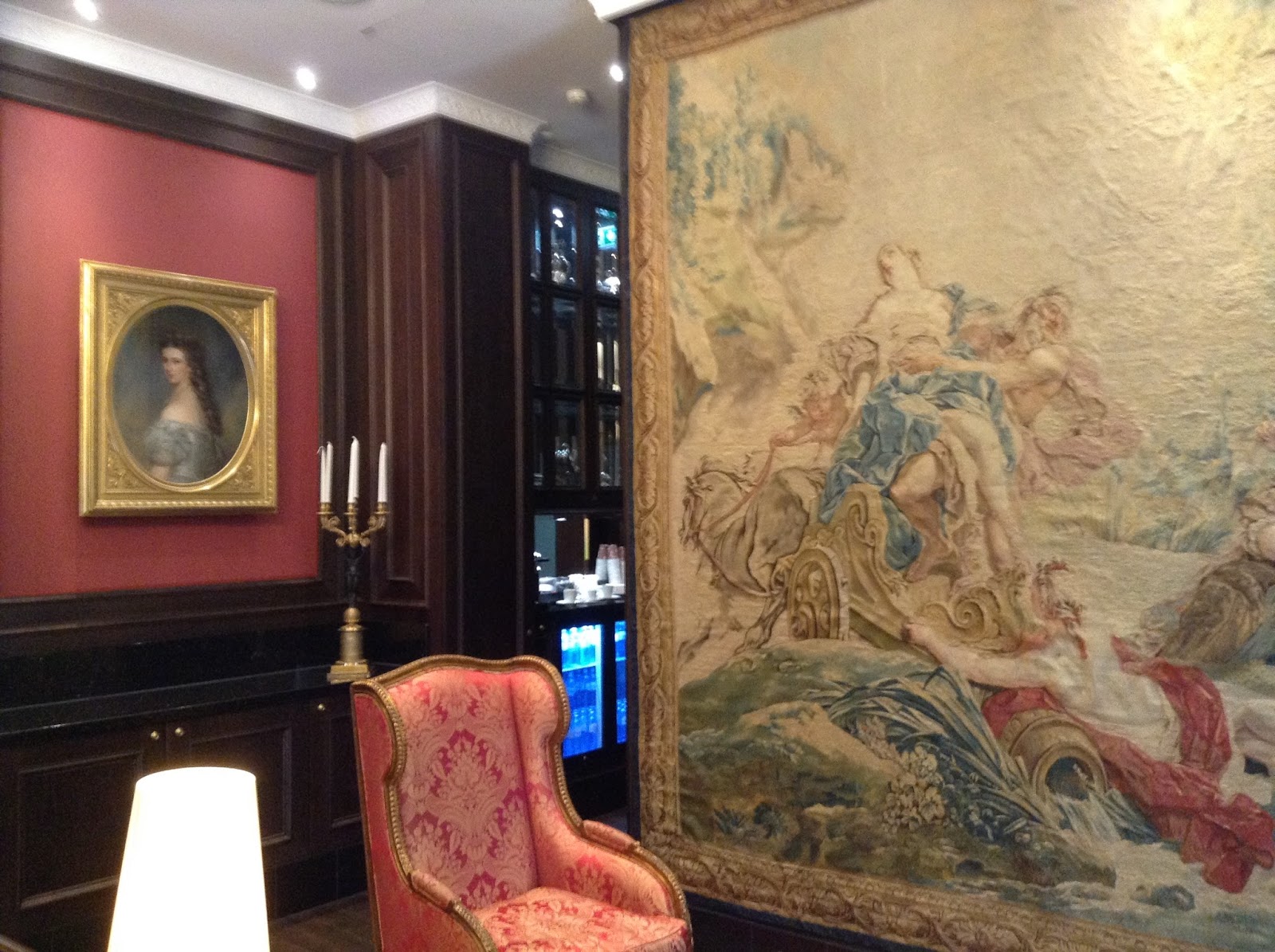
Vienna, as a major tourist destination, still capitalizes upon and cultivates that royal legacy with which they were born. You can feel it, you can see it plainly in what they emphasize in their presentation to us visitors.
Here are two pics from our Vienna hotel:
Compare this ambiance to a pic I snapped from our first night in Prague:
You get the picture?
This morning in Hungary, I was recalling a statement that our Vienna tour guide had made when we were there last week. She was telling us about the financial patronage through which the Hapsburgs supported orchestral Music in Vienna during the Classical Age, which was during a period from about 1760 to 1810 or so.
Our guide spent a good while talking about the Emperor's favored composers, Mozart and Haydn. The music of these two composers embodies the dignified, perfectly structured character of Classical Music as it was appreciated and financed by powerful, order-cultivating imperial benefactors. Our guide Iva also mentioned that, toward the end of the Classical period, Beethoven became a recipient who benefited from those Hapsburg pursestrings. But Beethoven's status as a recipient of their order-cultivating, imperial patronage was somewhat questionable. His musical identity--his struggle to surpass the courtly bonds of Mozart/Haydn conventionality-- was always on the edge of something terribly new and disruptive. Ludwig stood, in fact, on the dizzying precipice of a new 19th-century eruption in music. And he knew it. His opus would not turn out to be a kind of music that proceeds from the calm waters of courtly, post baroque, Classical concerts.
Ludwig's music turned out to be expressive, emotional, even explosive. His orchestral movements were a harbinger of a newly-forming revolutionary age, a disruptive century to come. His booming symphonies resonated more with those Czech Bohemians than with his courtesan mentors Mozart and Haydn. Ludwig was a German from somewhere over there in the cauldron of the Rhine/Ruhr, an upstart. And even though he was able to obtain support from the imperial coffers, he was never the comfortable courtesan composer like Mozart and Haydn had been.
Our Vienna guide, Iva, mentioned this. She explained that the the imperial support for that unpredictable young German was of a different nature. The times they were a-changing. Ludvig von Beethoven wasn't the mere conveyor of those raucous new symphonic strains; he was an (if not the) originator of the new romanticism in music. When Iva concluded her spiel on the great music that had come out of imperial Vienna, I felt that there was something she had left out.
(Excuse me) "What about Strauss?" I asked.
Her answer surprised me.
She said that the Strauss music--the waltzes, the Blue Danube, et al which came later in the 19th-century--were considered by the Vienna Establishment to be "pop music." They were equivalent to the "Dirty Dancing" of that time.
Strauss waltzes, the "Dirty dancing!" ?? of that day?
Duh! ????
She said that Strauss went to Chicago and did a concert for a hundred thousand people.
But that did not impress the Establishment in Vienna. As far as they were concerned, Johann Strauss Jr and his thumping waltzes were in the same league with . . . dirty dancing.
I suppose the royals and their courtesans always preferred their little, intimate venues like this one in Vienna, a space where, as our Vienna guide explained, Mozart had done one of his last concerts.
I will never get a handle on how all this human art and music plays out.
Glass Chimera
Labels:
Austria,
Beethoven,
city identity,
classical music,
Czech,
great cities,
Haydn,
Mozart,
Music,
Prague,
Strauss,
travel,
Vienna
Thursday, January 29, 2015
A World in Harmony, or Not

This morning I am watching the sky over Athens, Greece, as a new day brightens this fascinating city.
Yesterday, Pat and I toured the Acropolis, a mountaintop collection of ancient Greek temples. Greeks of 2500 years ago believed in a multiplicity of gods who were contending with each other for power.
I woke up thinking about their pantheon of many gods, and how different that belief is from my Christian faith in One God.
Believing in one God means the world is in divine harmony, because God made the world the way it is supposed to be. This belief enables me to reconcile the obvious contradictions of good and evil in this world.
The pagan religion, it seems to me, does not enable a believer to adequately find true harmony in this world, because all the "gods" or forces of nature or spiritual forces, are contending with each other. Therefore there is no ultimate reconciliation of good vs. evil.
Is the universe in harmony with itself, or not?
So this morning I am considering this idea of harmony, or not-harmony. Is the world humming along in a harmony that was coded into it by a Creator? Or is it just a bunch of god-wannabe forces working against each other?
Just looking around in the world as it presently exists, it seems more like the latter.
Being a musician, I began to consider musical harmony. Think about the perfection that Mozart manifested in his symphonies and sonatas. Lots of harmony and perfect precision there. It's nice to listen to, and very impressive. But I prefer the dynamic, existential dissonance of Beethoven's music. Why is that?
Is there something about the dis-harmony, or dissonance, that is more appropriate, or more true, than appreciating a harmony that doesn't really exist?
But let me go back a little further in musical time that Mozart and Beethoven.
Harmony and dissonance in music go back further than those two geniuses.
A half a century or so before them were Bach and Vivaldi.
Johann Sebastian Bach and Antonio Vivaldi were able to appropriate old modes and melodies that had been floating around since ancient (Greek, Indo-European, etc) times, and weave them into intricately constructed masterpieces of musical construction.
Bach was a pioneer in this; he was a genius. He experimented with the ancient Greek modes, blending them with tuneful elements of his own Germanic heritage to produce new inventions of musical expression that had never been heard, or even dreamed of, before. In fact, a series of his compositions are called "inventions." They are carefully constructed, in almost the same sense that the later sound-generating machines of Edison, Bell, or Marconi came to be known, in the late 1800s, as "inventions."
While Bach was the master inventor of the new (what we call baroque) music, Antonio Vivaldi was, during that same period, the grand master of musical passion. His universally popular "Four Seasons" (my all-time favorite) violin concertos express a level of instrumental virtuosity that surpass, by their emotional intensity, Bach's work, which is more cerebral or scientific.
Of course Bach had his emotions going hard-at-it too, but in a very different--what we might call a "German"--way. While Vivaldi was. . . from Venice. And. . . well, you know how Italians are, very expressive. (This all goes back, metaphorically, to the Greeks and Romans.)
Bach and Vivaldi were analogous to the Bill Gates and Steve Jobs of their age.
Just as Bach had propelled the world into totally new forms of music in the 1700s, Bill Gates, working in the late 1900s, wove computer software into a whole new world of innovative technology.
Just as Vivaldi had propelled the violin, oboe and other instruments into unprecedented explorations of emotional catharsis, so did Steve Jobs, by his unpredictable innovations make computers "sing."
While Bach was carefully constructing, on his keyboards, inventions of technical music wonder, Vivaldi was making the world ring, and sing, with creative passion.
There were others, of course, of that age: Telemann, Corelli, Pachelbel. Many great musicians during the baroque.
Then along came a prodigy: Mozart. He cranked out one masterpiece after another, and made it seem as simple as breathing. In Amadeus, music found its highest possible level of precise perfection.
Even so, listening to a meticulously perfect Mozart symphony or sonata does not pack the dynamic crescendo that would soon arrive under the masterful musical poetry of Ludwig von Beethoven.
What Bach did with the keyboard was raw creative genius, honed into exquisite constructions of sound. It is similar to what Gates did with software.
What Vivaldi did with instruments--violin, oboe--was pure passionate profundity, similar to what Jobs did with (what used to be called the computer) Apple.
Now, how did I, watching the day dawn in Athens, arrive at all this rumination about Bach, Vivaldi, Mozart, Beethoven, Gates and Jobs?
I don't know. How irresponsible of me.
I began this inharmonic quest about two hours ago with intentions that were totally different from what this essay has become. While watching a new day brighten the sky over Athens, I had an idea about the difference between paganism--belief in multiple gods or forces of nature that are contending with each other--and Christianity, which eventually dominated Greek (and European) culture. Having toured the Acropolis yesterday, I was considering all the huge architectural structures that the ancients had constructed here in Athens.
Those Greeks, and later the Romans, of ancient times seem to have been highly motivated with memorializing their devotion to a pantheon of many gods, mostly Athena and Zeus. They did so by building very large structures of architectural precision and grandiosity. I'm quite amazed, but there's something missing here.
Then a Hebrew teacher named Paul came to Athens. He saw all their temples and memorials devoted to the gods, and promptly proclaimed to them otherwise:
This pantheon, or multiplicity, of forces you are worshipping-- I have to break it to ya-- are not
truly gods. Rather, those entities are merely elemental forces in nature, and all of them subservient in power to One God:
YWHW, who sent his son to show us how to live and die.
What an innovator that Paul was. What followed is history, as Christian Europe would attest for the next 1900 years or so.
However, methinks some consequence, yet hanging in the world, shall bitterly begin with this year's contentions.
Glass Chimera
Subscribe to:
Posts (Atom)