Showing posts with label Empire. Show all posts
Tuesday, July 11, 2017
The End Room
For 600 years, a royal dynasty named Hapsburg ruled the vast European domains called Austria-Hungary.
In 1848, an emperor died; and so an emperor's son replaced him. From 1848 onward, Emperor Franz Josef ruled the empire for almost 68 years, until his death in 1916.
Franz Josef had a nephew named Ferdinand, whose place in the extended family would later qualify him as the heir to the throne at the occasion of Franz Josef's death.
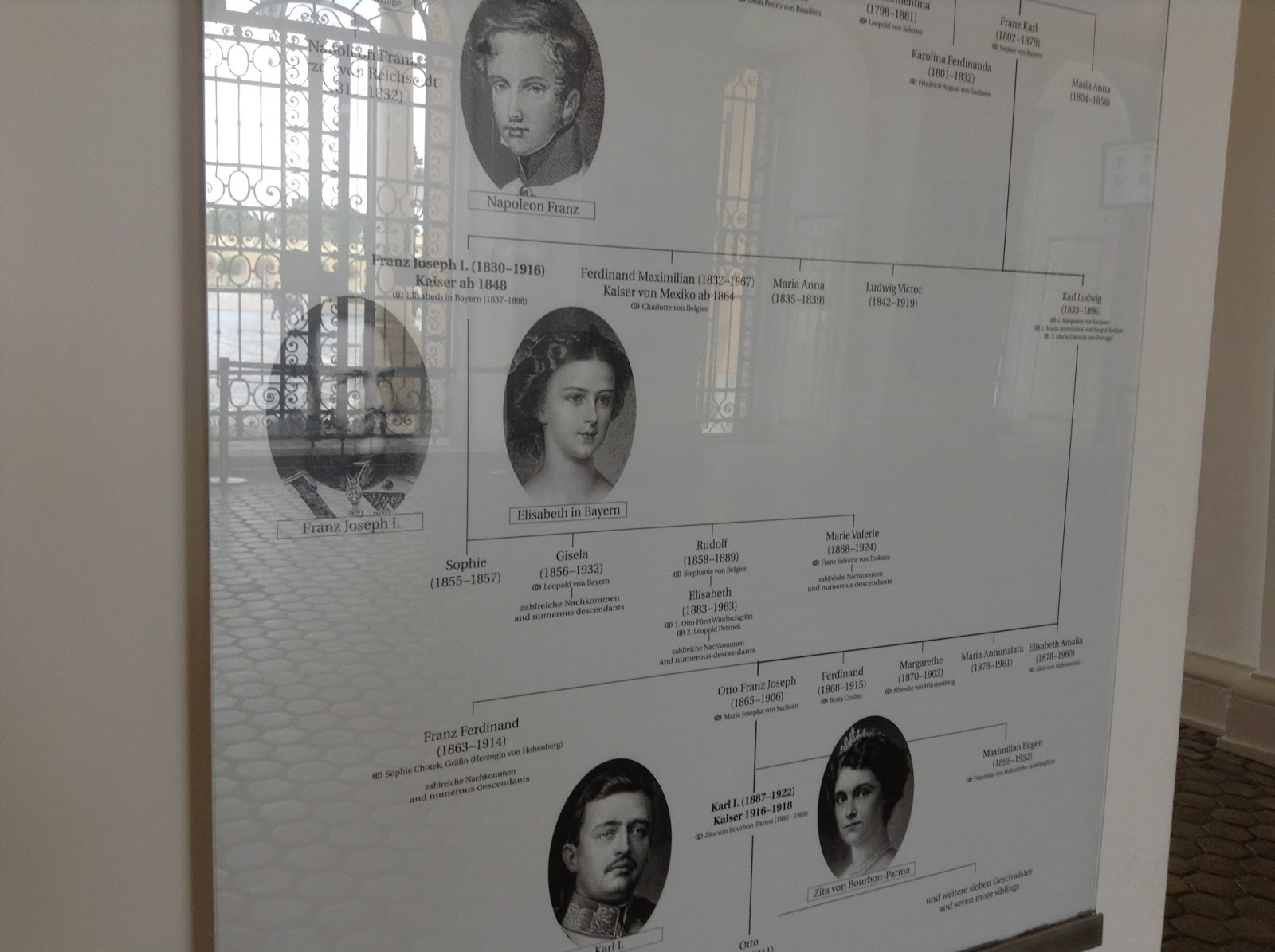
But Ferdinand never ascended to that throne, because he was assassinated in 1914. This assassination happened in Sarajevo, Serbia, on June 28, 1914. It is considered by most historians to be the fatal event that sparked the powder-keg of militarized Europe and ignited World War I.
But before all that, when Emperor Franz Josef was still ruling over the quasi-peaceful Austro-Hungarian empire, and the Hapsburgs were still lolling along as royalties habitually did, the royal family spent their summers at their summer palace near Vienna.
It is a place called Schonbrunn.
We visited the palace at Schonbrunn as tourists. As I was walking through the "royal apartments," the audio-guide mentioned that Franz Josef was a real go-getter when it came to performing his roles as Emperor. I got the impression that he was a workaholic monarch who spent his entire day, every day, dealing with matters of state. It makes sense if you think about it, because. . .
Ruling over an empire is no easy task. But in fact, it ultimately proved to be an impossible task. After his nephew Ferdinand, the heir, was assassinated, things really got out of hand for Franz Josef and the Hapsburg monarchy.
The whole royal arrangement really started to unwind when he demanded restitution from them upstart Serbs down there in Sarajevo who had shot his nephew.
But a Serbian concession was not going to happen. The Serbs did not like being subjects to Austrian control; they wanted to have their own country. Franz Josef's ultimatum soon became a declaration of war. Next thing anybody knows, there's a whole damn alliance-mongering world war exploding all over the place, because one very important man was shot to death.
Cutting toward the chase here, I must say that about half-way through that war, the old Emperor Franz Josef died, in 1916. So the Austro-Hungarian Empire was in need of a new Emperor.
But nephew Ferdinand, the would-have-been heir, could not ascend to the throne at that time, because he had been assassinated.
Therefore, the scepter of royal authority of the house of Hapsburg passed to another nephew, Karl. Karl was the nephew of the nephew and therefore the next in line to be Emperor of the Austro-Hungarian empire.
But this would be no easy task for young Karl. The prospect of assuming that royal authority must have been, in the wrath of an escalating world war, akin to accepting the gift of a hornet's nest. Most all the European potentates and their armies were mad as hell at the German Kaiser Wilhelm and his Austrian co-potentate, the erstwhile Emperor of Austria-Hungary. The wrath of Republican Europe was fast mounting fiercely to dismantle their Entente Axis of presumptuous military power.
But at a terrible cost: millions of lives perished in World War I.
Emperor Franz Josef's death in 1916, only half-way through the hostilities, was for Karl, more an overwhelming burden than some whoopdeedoo ascension to kingly privilege. His uncle's prickly challenge to the Serbs had rendered Europe into a grand bloody mess.
So in the year 1918, a scant two years after his accession to the throne, Karl was in no position to wheel and deal on behalf of Austria, or Hungary, or his supposed royal realms, or any other entity except, perhaps, for his immediate family. He was between a rock (Germany) and a hard place (the Allies who were hell-bent on demanding reparation from Germany and Austria.)
This was no easy position for a young monarch to be in.
As we traipsed through the royal apartments of Schonbrunn last Monday, the audio-guide informed me that I had just entered a certain room where, in 1918, a gang of both friends and foes of the Emperor had presented to young Karl his choices pertaining to the Empire.
Karl's choices were not pretty. The military leaders, diplomats, politicians in that room told him that they were taking the whole damn empire away from him and his family. He was in no position to argue with them, so that was where it all ended for the Hapsburgs. Therefore he had no choice but to concede to their demands.
So Karl and the Hapsburgs lost it all, right here in this room.
Except one thing. Karl refused to abdicate. He managed to slink away still having his title.
Whatever that means, I thought, while standing there with all my fellow-tourists in the room where a 600-year empire had ended. Karl would still be Emperor, but emperor of what? His own kingdom exiled him.
At that moment, I accidentally snapped a contraband photo:
This is where it all ended for the legendary Hapsburgs. As cousin George said later, all things must pass.
Smoke
Saturday, February 21, 2015
Back to the future of Religion
Human history is full of walls. Everywhere people have gone upon the earth, they have built walls. Walls can keep good stuff in and bad stuff out, or the other way around.
For instance, consider this wall, which we encountered in Rome when we were there a few weeks ago:
Beyond this wall lies the body of Western Civilization. . .
if you consider the history of the Christian Church as a primary trunk of Western Civilization.
Not everybody does of course. Some folk are not believers, but rather thinkers, like the early, pre-Christian Greeks. . . Socrates, Plato, Aristotle, etc. etc. . . Descartes, Locke, Marx . . .etc.
http://en.wikipedia.org/wiki/Ancient_Greek_philosophy
Many people in Western Civilization understand the difference between thinking and believing this way: they are mutually exclusive, two different animals. You either spend your life thinking, or you spend your life believing what is taught to you.
This is not true; it's a false dichotomy.
I myself am living example of this. I am a Christian believer, and yet I do like to think analytically about everything, including faith itself.
This I have concluded: Faith is what you find at the end Thought.
In other words, when you've exhausted your brain in trying to figure life out, then you start believing in something besides thinking itself.
In my youth, I considered the Catholic Church, in which I was raised. And I decided it was for the birds.
I took a look at Philosophy, and decided I couldn't not understand enough of it to make sense of the real world.
I studied the Law of Moses, and learned that I could not live by it.
Recently, I studied a little bit about Mohammed, because, well, you know. . . he and his followers are all the rage. Mohammed was a very smart guy, probably even a genius, but he was obviously a man, like me and you. His visions and ultimate indoctrinations were human, not divine. The outcome was True Religion by Intimidation.
Jesus Christ, on the other hand, laid down his life rather than settle for merely human solutions to our predicament. Now there's a man I could follow, even though he went to the cross and suffered death. He was pure goodness, and I could follow him through death's door, all the way to eternal life.
Of course that's what Peter, his right-hand man, said about Jesus: I will follow you.
Then he went on to stumble through life, like me or you or any other human being. I look forward to interviewing him in heaven. I can relate to his resolution to follow Christ, even though he screwed up on more than one occasion.
A lot of things were done, in subsequent Christian history, in Peter's name. There's the Chair of St.Peter, St. Peter's Basilica, etc.
http://en.wikipedia.org/wiki/Catholic_Church
Which leads me back to Walls phenoma. . .people building walls. Consider the one pictured above, in the great city of Rome. This wall was built by the Catholics to protect the museum part of St.Peter's Basilica (in the Vatican.) Pretty impressive wall too, don't you think. I was quite moved by its immensity; that's why I snapped the photo. It seemed so . . . medieval.
On the other side of it, as I later learned, is the Vatican Museum, which is why I say therein lies the body of Western Civilization . . .
In a metaphorical kind of way, and even then only if you're a person inclined to place value on religious traditions and institutions.
Like Tevya, you know. . .Tradition! tradition. Tradition.
Well guess what. Life goes on. That day in Rome, after the big brown wall image was safely in the iPhone, Pat and I resumed our walking tour of the city. It was a beautiful experience.
But just so you'll know what a backward thinker I am, here's a different photo that I had snapped about a week earlier, in Athens:
This is a statue of Constantine XI Palaiologos. He was the last emperor of the Byzantine empire.
He was killed by the invading Ottoman Turks in 1453. He died defending Constantinople, the epicenter of Orthodox Christianity during that period of history. The empire that he ruled, the Byzantine, had been trying to build a Wall, of sorts, a wall of Christian religion and dominion that would withstand the onslaught of Muslim Ottomans, but Byzantium could not withstand the Ottomans. So now the place is called Istanbul.
But such is the fate of Western Civilization's aspirations for world dominion. Orthodox Christendom and the Byzantine empire that defended it could not stand against the onslaught of Islam in 1453.
Later however, the Ottoman empire suffered its own demise, in 1924, after Western Civilization imposed a new victory over the Ottoman Caliphate in the aftermath of World War I.
Alas, nowadays we Civilized persons of the West face a new Islamic Pretender. This one, arising in ancient Syrian lands, is claiming to recover the lapsed Caliphate mantle which had been worn for a few centuries by the Turks, even though the arrogant ISIS brutes do not acknowledge the Ottoman legacy as a legitimate Caliphate.
Consequently, we survivors of Western Civilization are now building a new network of Walls: digital walls, firewalls, psychological walls, spiritual and moral walls, to arrest the shock and awe of "violent extremists."
Ultimately, we will have to erect some military walls, both defensive and offensive, before it is all over with, the end of the world or whatever.
Or just the end of Western Civilization. Then where will the body lie?
Whatever happens, our opposition to the jayvee-team fascists of the Khilafah will not end as Constantine XI's last stand ended in 1453; nor is it likely to be enshrined within the walls of the Vatican Museum.
Smoke
Subscribe to:
Posts (Atom)