Showing posts with label monarchy. Show all posts
Friday, September 14, 2018
Two Towers
Two Spanish towers stand as symbolic descriptors of that country's monarchy.
It only takes a glance to catch a glimpse of the difference between the two historical ages in which these two were constructed.
One ancient tower, pictured below, was built on the Mediterranean coast, at Valencia, between 1441-1460 AD.
The new one, to be seen further below, was constructed in Madrid in 1992.
They are very different. A comparison between the two indicates, I think, a major difference between Spain's early monarchy five centuries ago, and the constitutional monarchy that functions today.
When I look at the older tower, which I snapped on photo this morning, the picture summons in my mind mythical images of a medieval kingdom ruled by kings and protected by an order of loyal knights. In this case, the kingdom was Aragon, in was in eastern Spain, 15th century. The nominal ruler at the time was King Alfonso V.
Because medieval royals moved around Europe like corporate CEO’s who jet around the world today, Alfonso wasn’t very involved in the Spanish parts of his domains; he was preoccupied with Italia and papist politics.
So Alfonso’s brother, prince John, held down the fort (literally) over in the outback Spanish hinterlands.
The task then fell to John, or some of his people, to govern and protect the good people of Aragon. In the main cuidad, the port of Valencia, they built walls around the city, and towers for monitoring the distant horizons. Here’s the tower, obviously still standing, that I snapped this morning.
Doesn’t it absolutely look like the elevated station of a classic medieval fortification wall? Could it be jutting up into the blue sky of at Aragorn instead of Aragon? We see here that Prince John literally “held down the fort” while his big brother was schmoozing with the Italian movers and shakers of their day and their papist pals.
Prince John did acquire, however, a significant role in history. He was the the father of a Ferdinand. That’s the Ferdinand of Ferdinand and Isabella, who commissioned Christopher Columbus to sail for India. Chris never did make it India; but he did bump into another place. . . America.
And the rest is history.
When King Ferdinand of Aragon married Queen Isabella of Castile--that was the beginning of the nation we know to be Spain.
Fast-forward 532 years from Prince John’s constructed wall/Tower to defend Valencia in 1460 AD. By 1992, when my second example of a tower is built, the people of Spain have done significant rearrangement of this governmental arrangement called monarchy. They have democratically kicked out one 20th-century king, Alphonso XIII, in 1931. They replaced his monarchy with a leftist Republic that lasted only until 1939. Then the military Generalissimo Franco summoned a bunch of old-fashioned Catolico, conservative, reactionary and fascist soldiers; he drove them up from Morocco, took hold of Espanya by winning the civil war of 1936-39; he chased away most of the republicans, socialists, communists and any other liberal-minded upstarts who thought they could rearrange Spain according to egalitarian ideals and modern ideas.
Franco ruled, king-like, as a Falangist dictator, from 1939 onward, and managed to hang onto power in spite of all his nazi and Italiano fascisti allies going down in death and disgrace in 1945 after the Big War.
He ruled until he croaked in 1975. But before he died, Franco twisted arms in the corridors of Spanish power to prevent his people from voting in another experiment with democracy.
They must restore the monarchy, insisted the Generalissimo. But they should not crown the royal son who would have been presumptive heir—no, not Don Juan, 3rd son of the late and last King Alphonso who they turned away in '31 Rather, Franco insisted Spain should crown Don Juan's son, Juan Carlos, whose inclinations appeared to be more authoritarian than Don Juan’s.
Nevertheless, after Franco had passed into the great beyond in ’75, the new king Juan Carlos responded with approval for the democratic reforms necessary to bring Spain into modern governance. He instituted reforms that would relegate the monarchy toward more ceremonial duties, a la Britain, the Netherlands, Sweden and several other nations. Today Alfonso’s great-grandson, Juan Carlos’ son Felipe VI, is the king of Spain.
In Madrid, 1992, Spain built a museum to display the modern art of their country. King Felipe’s mother, Sofia—herself of royal Spanish blood as well as being Juan Carlos’ wife and queen—gave her name to the completed project of the new art museum.
A sleek, transparent glass elevator shaft on the Museum’s exterior stands out as a bold work of architectural art, in and of itself. It’s name is prominently etched along the entire vertical length of the structure.
This shiny Tower, which conducts elevators, expresses the innovative thrust by which Spain has ascended into the modern world.
So we notice two incredibly different towers in Spain: one made of stone, appearing very heavy, very old, and fortress-like impenetrable. The other is constructed of glass, gleaming brightly in 2018 sunshine, appearing light and fragile. This second one also has a symbolic name--Reina Sofia, which was not only the Spanish queen's means; it also means Queen Wisdom.
What remains to be seen is the future of Spain’s monarchy-retaining democracy. Is it fortified and impenetrable, or light and fragile, like a smart phone you don't want to drop.
That question is really a manner of consideration for all democratic governments. We shall see what the world does to all our democracies during the next half-millenium. Let's hope they are still functional 500 years from now, whether kings and queens are still part of the structure, or not.
My thought is it would be wise to keep democracy intact and functional, whether or not kings and queens are still part of the arrangements.
Smoke
Labels:
Alfonso,
history,
Juan Carlos,
Madrid,
monarchy,
Queen Sofia,
Spain,
Spain Museum of Modern Art,
towers,
Valencia
Tuesday, March 20, 2018
The Castle Paradox
Once upon a time, and oh, so far, far away from these here United States, many of our ancestors lived and worked in the Old Country.
It was a feudal society over there. The royal houses would feud among themselves while their servants labored to bring home the bacon.
Back then, the countries had not even assembled themselves into nations yet. The lands of the Old Country were divided into kingdoms and fiefdoms. Vast estates were owned and ruled by kings and queens, princes and princesses, dukes and duchesses. In the domain of each royal arrangement, lords and ladies would call the shots, while their loyal serfs and vassals would toil every day, out in the hinterlands amongst the hedgerows and fields where they produced a bounty of crops and goods. In this manner, everybody—the royals and the peasants— were fed and housed, and even in some cases fat ’n happy.
Or so the story has been told. . . once upon a time, in a land far, far away.
By ’n by, the times they were a-changin’ and all things became different from what they had been before.
Fresh breezes of liberty swept through the hearts and minds of men and women. Notions of liberty and equality arose among the people. These zeitgeist winds of change compelled many a former vassal to cast off the ancient bonds of indentured servitude. Many a craftsman forsook the security of the royal house, to move into town and set up shop. Striking out on their own, many a blacksmith, many a weaver, butcher, baker and candlestickmaker established paths of industrious productivity of their own, apart and independent from the Old Order.
And a New Order arose in the Old Country.
Long about this time, folks heard about a new place called America, and . . . well, you know the story. All this American stuff that you see around us now rose up in about two or three hundred years, whereas the heavily stratified infrastructure of the Old World had taken two or three thousand years to develop.
By ’n by, here in America, we got fed up with King George and his taxing shenanigans. We threw his red-coated soldiers out, sent ‘em packing back to Britain with their tail between their legs.
Our American revolution was no small accomplishment. A lot of our people, having caught a whiff of that Enlightened wind, got inspired toward liberty big time, and so we took up our muskets and fought our way to independence. Many a minute man and backwoodw farmer died while defeating them redcoats at Bunker Hill and Yorktown and Valley Forge.
But really it was a walk in the park compared to the bloody French Revolution, which came a few years later in the Old Country. Those madcap peasants chopped the king’s head off and the queen’s head and a lot of other royal heads, heads of privilege, heads of power, even a bunch of innocent heads, because the rabble crowds, so caught up in their egalitarian frenzy went plum crazy once the blood started to flow in the streets and sewers of Paris. Those furious French shocked their way into the 19th-century, whereas we merely fought our way into it.
You see, those French revolutionaries were dealing with ancient bands of power that went way back in time; there was huge institutional baggage that they felt they had to throw out with all those bloody royal heads.
Whereas, we here in America only had to send the king and his army packin’ back to England. Once we had gotten rid of them, we only had a vast, undeveloped virgin contintent to deal with.
We had four thousand miles of opportunity stretched westward before us, whereas the proletarians of Europe had thousands of years of old habits and old baggage to try to reconstruct in order to usher in a New Order. Those former vassals found themselves with a lot of unpleasant work to do before they could see their way clear to this new thing called democracy and/or republic. (Actually the liberating notions were very old, but that’s another story, a Greek and Roman one.)
Well, by ’n by, the times were a changin’ . . . but sometimes things have to take a few steps backward before the forward motion cranks up again.
Whereas, in the Olden days Once upon a time, all the peasants were gathered around a castle, now it seems we’ve found, in our modern liberty, ourselves a new castle to gather around. . .
Now that every man is a king, every woman a queen of her own destiny, now that every son is a prince and every daughter a princess, the New Order has morphed into a revised version of the Old Order. What goes around comes around. Take your place on the great Mandela. Millions of us from all over the world congregate at a New Castle every year, yearning for something special, hoping to find something magical, wishing upon a star . . .
What is it we’re really wishing for?
King of Soul
Labels:
america,
castles,
Disney,
Europe,
feudalism,
history,
indentured servitude,
kings and queens,
liberty,
monarchy,
New Order,
Old Order,
order,
princes and princesses,
revolution,
royalty,
serfs,
vassals
Tuesday, July 11, 2017
The End Room
For 600 years, a royal dynasty named Hapsburg ruled the vast European domains called Austria-Hungary.
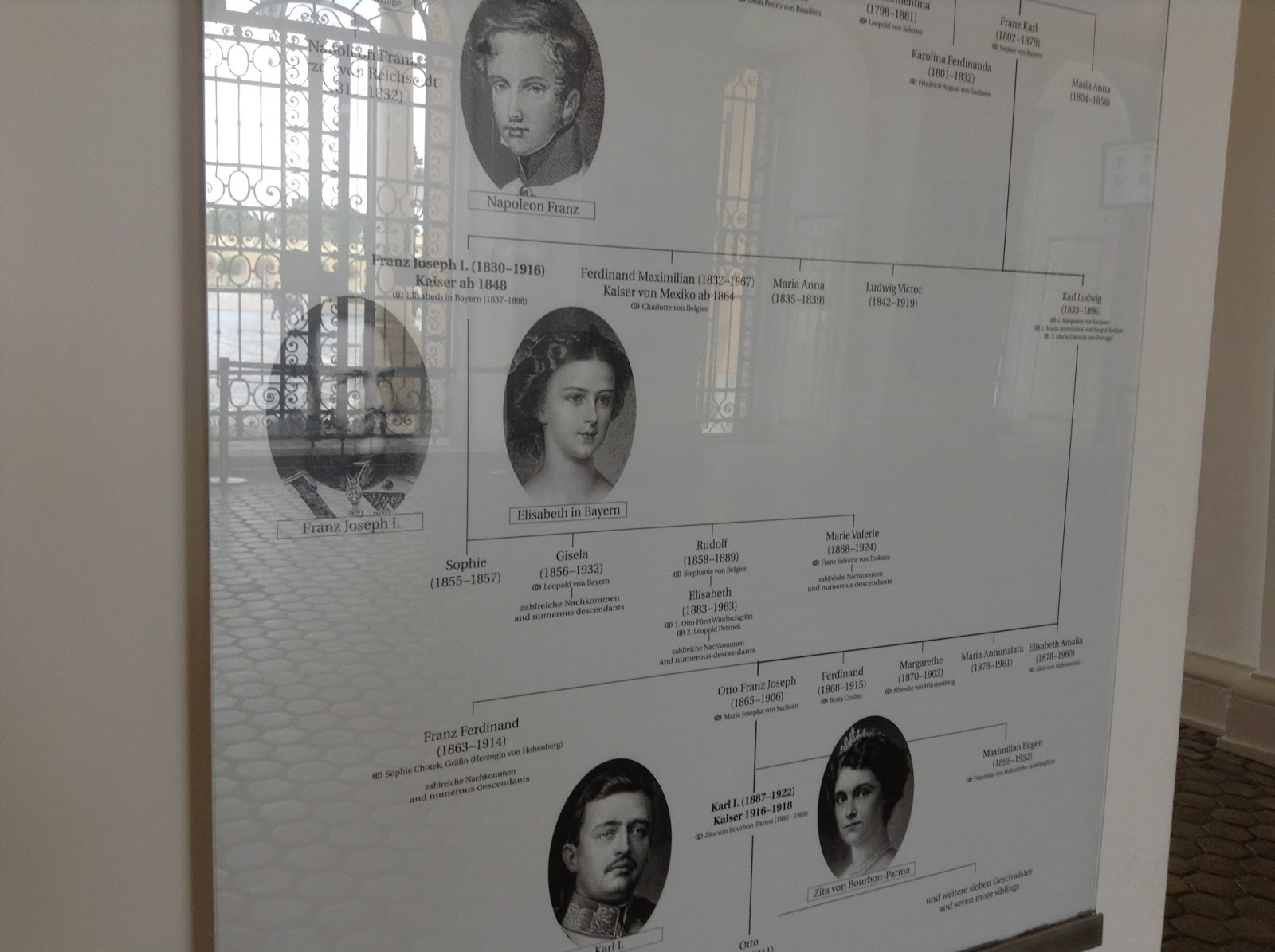
In 1848, an emperor died; and so an emperor's son replaced him. From 1848 onward, Emperor Franz Josef ruled the empire for almost 68 years, until his death in 1916.
Franz Josef had a nephew named Ferdinand, whose place in the extended family would later qualify him as the heir to the throne at the occasion of Franz Josef's death.
But Ferdinand never ascended to that throne, because he was assassinated in 1914. This assassination happened in Sarajevo, Serbia, on June 28, 1914. It is considered by most historians to be the fatal event that sparked the powder-keg of militarized Europe and ignited World War I.
But before all that, when Emperor Franz Josef was still ruling over the quasi-peaceful Austro-Hungarian empire, and the Hapsburgs were still lolling along as royalties habitually did, the royal family spent their summers at their summer palace near Vienna.
It is a place called Schonbrunn.
We visited the palace at Schonbrunn as tourists. As I was walking through the "royal apartments," the audio-guide mentioned that Franz Josef was a real go-getter when it came to performing his roles as Emperor. I got the impression that he was a workaholic monarch who spent his entire day, every day, dealing with matters of state. It makes sense if you think about it, because. . .
Ruling over an empire is no easy task. But in fact, it ultimately proved to be an impossible task. After his nephew Ferdinand, the heir, was assassinated, things really got out of hand for Franz Josef and the Hapsburg monarchy.
The whole royal arrangement really started to unwind when he demanded restitution from them upstart Serbs down there in Sarajevo who had shot his nephew.
But a Serbian concession was not going to happen. The Serbs did not like being subjects to Austrian control; they wanted to have their own country. Franz Josef's ultimatum soon became a declaration of war. Next thing anybody knows, there's a whole damn alliance-mongering world war exploding all over the place, because one very important man was shot to death.
Cutting toward the chase here, I must say that about half-way through that war, the old Emperor Franz Josef died, in 1916. So the Austro-Hungarian Empire was in need of a new Emperor.
But nephew Ferdinand, the would-have-been heir, could not ascend to the throne at that time, because he had been assassinated.
Therefore, the scepter of royal authority of the house of Hapsburg passed to another nephew, Karl. Karl was the nephew of the nephew and therefore the next in line to be Emperor of the Austro-Hungarian empire.
But this would be no easy task for young Karl. The prospect of assuming that royal authority must have been, in the wrath of an escalating world war, akin to accepting the gift of a hornet's nest. Most all the European potentates and their armies were mad as hell at the German Kaiser Wilhelm and his Austrian co-potentate, the erstwhile Emperor of Austria-Hungary. The wrath of Republican Europe was fast mounting fiercely to dismantle their Entente Axis of presumptuous military power.
But at a terrible cost: millions of lives perished in World War I.
Emperor Franz Josef's death in 1916, only half-way through the hostilities, was for Karl, more an overwhelming burden than some whoopdeedoo ascension to kingly privilege. His uncle's prickly challenge to the Serbs had rendered Europe into a grand bloody mess.
So in the year 1918, a scant two years after his accession to the throne, Karl was in no position to wheel and deal on behalf of Austria, or Hungary, or his supposed royal realms, or any other entity except, perhaps, for his immediate family. He was between a rock (Germany) and a hard place (the Allies who were hell-bent on demanding reparation from Germany and Austria.)
This was no easy position for a young monarch to be in.
As we traipsed through the royal apartments of Schonbrunn last Monday, the audio-guide informed me that I had just entered a certain room where, in 1918, a gang of both friends and foes of the Emperor had presented to young Karl his choices pertaining to the Empire.
Karl's choices were not pretty. The military leaders, diplomats, politicians in that room told him that they were taking the whole damn empire away from him and his family. He was in no position to argue with them, so that was where it all ended for the Hapsburgs. Therefore he had no choice but to concede to their demands.
So Karl and the Hapsburgs lost it all, right here in this room.
Except one thing. Karl refused to abdicate. He managed to slink away still having his title.
Whatever that means, I thought, while standing there with all my fellow-tourists in the room where a 600-year empire had ended. Karl would still be Emperor, but emperor of what? His own kingdom exiled him.
At that moment, I accidentally snapped a contraband photo:
This is where it all ended for the legendary Hapsburgs. As cousin George said later, all things must pass.
Smoke
Subscribe to:
Posts (Atom)