Showing posts with label war. Show all posts

Wednesday, May 6, 2020

Say it ain't So

These are perilous times in many ways:
Perilous pandemic
Perilous politics
Perilous protests
Perilous proclamations
Perilous pandemonium
Perilous publications
Perilous panic
Perilous parlance
Perilous pathogens
Perilous politicians
Perilous partisans
Perilous Powers

I heard a perilous report this morning. I found myself wishing some wise person would or could refute the perilous parlance I heard.
I was thinking: Say it ain’t so!

~Say it ain’t so: that the CCP are out to get us.
~Say it ain’t so: that the CCP unleashed the perilous pandemic with intentions of debilitating the US.
~Say it ain’t so: that the CCP place no value in human life.
~Say it ain’t so: that the CCP leaders are willing to sacrifice large swathes of their own people to the Covid just for the sake of having an alibi.

~Say it ain’t so: that the CCP want to dispose of many of their own old people because they’ve got too many of them due to their past one-child policy.

~Say it ain’t so: that Xi’s heroes are Hitler and Stalin.
Say it ain’t so!
~Say it ain’t so: that the CCP are willing to make a deal with Perilous Putin to debilitate North America with Covid and then divvy it up so that Ruskies can have Alaska back and CCP can grab USA to repopulate it with their presently overpopulated people.

Say it ain’t so!
~Say it ain’t so: that we actually have Americans who claim that our nuclear arsenal is obsolete and needs to be upgraded.

Say it ain’t so!
~Say it ain’t so: that any leader would even think about firing one of those damned warheads.
~Say it ain’t so: that we are headed for another world war.
Somebody please say it ain’t so.

Tiananmen talk

Somebody please prove to me that all the above Perilous Reports are not true and they  could never happen.

More likely, however, than someone actually proving that to me is:
that I would do better to put aside this perilous rant and resort instead to a different “P” plea to hang my hopes on: 
Pray!
Pray it ain’t so.

Perhaps you'll join me. Pause for a word of Prayer for all People everywhere and for the imperiled Planet we inhabit.

P.S. If you are Chinese, and reading this . . . Please don't take this wrong way.
Have a nice day.

Glass half-Full

Sunday, May 26, 2019

Death by War

I wrote a story about an American traveling through Europe in the spring/summer of 1937. In the novel, Smoke, which I published in 2015, young businessman Philip Morrow accepts an unusual errand, which takes him through London, halfway around the far side of France, then to Paris, and ultimately to arrive at a place called Flanders Field in Belgium.

At his specific Memorial battleground destination, Philip sees for the first time the final resting place of his father, a soldier of the American Expeditionary Force, who had died there in 1918 during the last week of World War I.  Philip had been eight years old in 1917 when he hugged his pa for the last time, then  beheld  his mother while she tearfully embraced her  husband, a mountaineer marksman named Clint. 

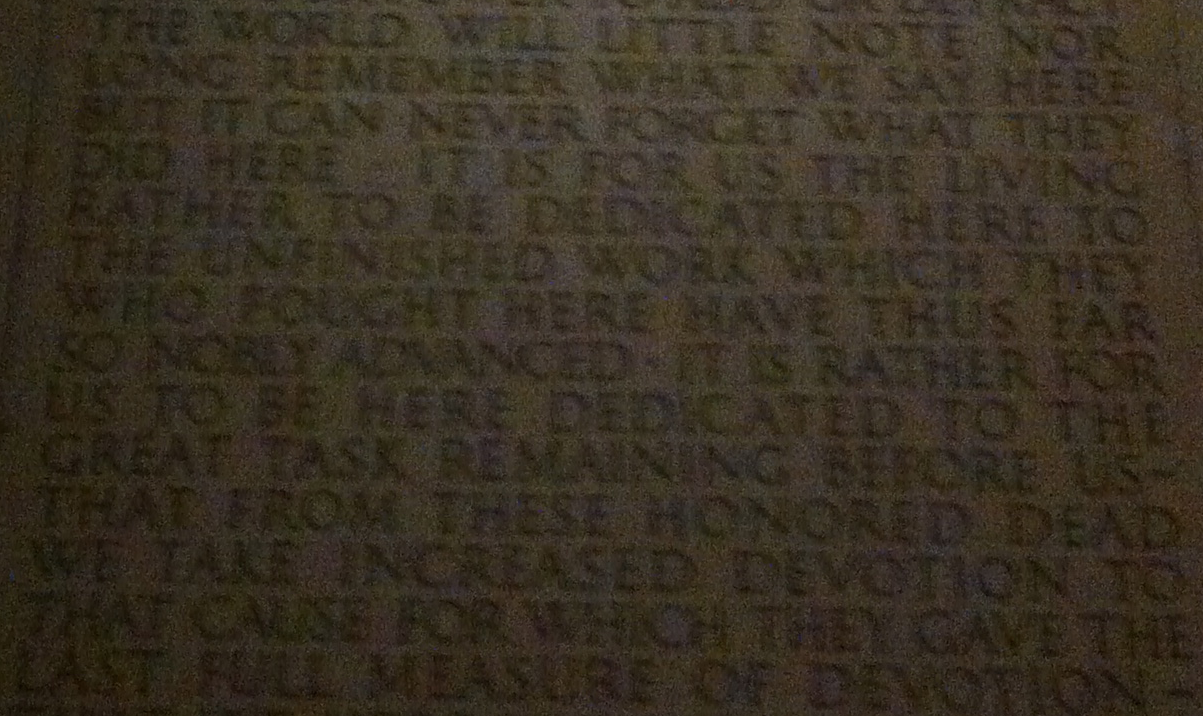
In chapter 27 of Smoke, Philip arrives at the Memorial cemetery accompanied by a newfound friend, Mel, an old Frenchman who expresses his appreciation for Clint's courageous sacrifice--given in his last full measure of devotion-- for freedom, to defeat tyranny.

Clint's total offering in 1918 was not the first, nor the last, to be put forth by millions of other soldiers since that time. In Washington DC, I snapped this photo of a newer Memorial--that one constructed for us to remember the dead of Vietnam.
VNMem (1)

We Americans do appreciate the families left behind.  Their sorrow and sacrifice is painfully precious; it  runs deep--deep as the blood that pumped through soldiering bodies alive with determination--blood that still streams through the beating hearts and minds of  us Americans and Allies.

Here's my offering, from chapter 27 of Smoke:
       “How could this place have been a battlefield for a world war?”
       'The old Frenchman cast his eyes on the passing landscape, and seemed to join Philip in this musing. He answered slowly, “War is a terrible thing, an ugly thing. I did not fight in the war; I had already served my military duty, long before the Archduke was assassinated in Sarajevo and the whole damn world flew apart, like shrapnel. But I had many friends who fought here, and back there, where we just came from in my France, back there at the Somme, the Marne, Amiens. Our soldiers drove the Germans back across their fortified lines, the Hindenberg line they called it. By summer of 1918 the Germans were in full retreat, although it took them a hell of a long time, and rivers of spilt blood, to admit it. And so it all ended here. Those trenches, over there in France, that had been held and occupied for two hellish years by both armies, those muddy hellholes were finally left behind, vacated, and afterward . . . filled up again with the soil of France and Flanders and Belgium, and green grass was planted where warfare had formerly blasted its way out of the dark human soul and the dark humus of lowland dirt and now we see that grass, trimmed, manicured and growing so tidily around those rows of white crosses out there, most of them with some soldier’s name carved on them, many just unknown, anonymous, and how could this have happened? You might as well ask how could. . . a grain of sand get stuck in an oyster? And how could that oyster, in retaliation against that rough, alien irritant, then generate a pearl—such a beautiful thing, lustrous and white—coming forth in response to a small, alien presence that had taken up unwelcomed residence inside the creature’s own domain? The answer, my friend, is floating in the sea, blowing in the wind, growing green and strong from soil that once ran red with men’s blood.” '
       "Now they were arriving at the battlefield. Jacques parked the car, leaned against the front fender, lit a cigarette. Mel and Philip walked through a stone arch, along a narrow, paved road lined with flowering linden trees, spring green with their large spadish leaves, sprinkled with small white blossoms. The sun was getting low behind them. Shadows of these trees had overtaken the narrow lane, turning it cooler than the surrounding fields, acres and acres neatly arranged with white crosses and gravestones, and continuous green, perfect grass between all. Having reached the end of the linden lane, the stepped slowly, reverently, along straight pathways, passing hundreds of silent graves on either side. The setting sun was still warm here, after their cool approach from beneath the trees.
       "At length, they came to the row that Philip had been looking for, the one he had read about in the army guidebook, where his father’s grave was nested precisely and perpetually in its own place in eternity ". . .

King of Soul

Tuesday, July 10, 2018

Vietnam, at ground level 1970


Herein I recommend a novelized real story from that infamous "War in Vietnam."

  https://www.smashwords.com/books/view/13437

John Podlaski’s novel about a brand-new American soldier in Vietnam strikes at the heart of the matter— just what the hell were our soldiers over there supposed to be doing?

Them brave boys were  putting their asses on the line, stalking communist enemies in strange jungles on the other side of the world, when all the while their survival instinct was demanding them to just hunker down, lay low, and get through their year-long sentence of jungle warfare in one living, still-breathing piece.

And All for what?

Because we sent them to do a job—kill communists, and run the ones we couldn’t kill back to the North.

Now we all know it didn’t work out that way, but we learned some lessons—and the world did too—in the process.

The problem our guys had over there was: how could we know, in a SE Asian village scenario, which villagers were helping the NVA, and which ones were on our side? As if these rice-cultivating peasants knew the difference between Karl Marx and George Washington!

After reading this book, Cherries, it seems to me that, in the midst of the terrible gun battles, every soldier’s internal war must have been a constant conflict between these two missions: to kill enemies and thus keep the brass-mandated “body count” on an upward curve, or to stay alive!

Which would you choose?!

In most cases, it seems it came down to protecting yourself and your squad buddies, while treading fearfully through the booby-trapped minefield of two opposing international ideologies whose political strategies had turned absolutely, militarily lethal.

That project required real men—brave soldiers who could bite the bullet— who could launch out and give it a shot while death and danger stalked them at every turn along the path.

This was a terrible, terrible ordeal that our nation put these guys through! We need to talk about it.We need to acknowledge their incredible bravery.  We need to ask: Just what the hell happened back then and there in Vietnam?—in that war that so many of us managed to evade.  Whether you were for the war of against it— reading John Podlaski’s “Cherries” is a provocative way to begin the assessment— an evaluation that needs to take place, for the sake of our nation’s future security.

Read the book, because this quasi-autobiographical story gives a close-up, day-to-day, boots-on-the-ground account of what our guys were doing over there in Vietnam, while we were trying to figure it all out here, stateside— here, safe in the home of the free, while the brave were answering the terrible call that our government had imposed on them.  They endured that jungular hell-pit so that we, as a nation, could, in spite of defeat,  pass successfully through the 20th-century burden of Cold War paranoia.

John’s fictionalized personal story fleshes out the constant conflict between two soldierly inclinations: fulfilling military responsibility by driving up enemy “body counts,” vs. following  the human instinct to just stay alive, and somehow make it through your one-year tour of duty without getting your ass killed.


Our American purpose there was unclear. No definite battlefield could be found;  the war was waged wherever our boys happened to run into the Viet Cong or the North Vietnam Army, in a perpetual theater-game of deadly hide-and-seek. Our teens and twenties recruits and draftees were dropped into unfamiliar Asian jungles, then immersed immediately in extreme fear—fear like you would feel seeing two of your platoon-mates’ heads staked on bamboo poles.

Not in Kansas any more, Toto!

Khe Sahn. A Shau, Ah shit! What have we gotten ourselves into?!

Read John’s book to find out what perils our boys  were trudging through while we stateside were trying to figure out the whys and the wherefores.

BTW, by the 1990’s it was plain to see that  the free world, led by the USA, had prevailed in our struggle against both fascism and communism. In the big picture, our effort in Vietnam played an instructive role in that victory. The governance of nations has more to do with learning from your mistakes than fighting a lost cause to some idealized bitter end.


Thanks to you all you guys—Cherries, LongTimers and Lifers—who answered the call to service at that time. Oh yeah, and here’s another belated message: Welcome Home!

King of Soul  

Monday, May 28, 2018

What about that old battlefield?


In chapter 27 of my 2014 novel, Smoke, we find a young American, Philip, and an old Frenchman, Mel, conversing as they approach a battlefield in Belgium, a place called Flanders Field. The year is 1937;  in the last week of World War I, Philip's father had died on that battlefield in 1918. Here's the scene:

Something about the spring air, the mists at the edges of the fields, the lush, lowland foliage, the shadowy light, lijdt het licht het donk’re licht, something was moving deeply inside of him. “Mel?”

       “Yes?”

       “How could this place have been a battlefield for a world war?”

       The old Frenchman cast his eyes on the passing landscape, and seemed to join Philip in this musing. He answered slowly, “War is a terrible thing, an ugly thing. I did not fight in the war; I had already served my military duty, long before the Archduke was assassinated in Sarajevo and the whole damn world flew apart, like shrapnel. But I had many friends who fought here, and back there, where we just came from in my France, back there at the Somme, the Marne, Amiens. Our soldiers drove the Germans back across their fortified lines, the Hindenberg line they called it. By summer of 1918 the Germans were in full retreat, although it took them a hell of a long time, and rivers of spilt blood, to admit it. And so it all ended here. Those trenches, over there in France, that had been held and occupied for two hellish years by both armies, those muddy hellholes were finally left behind, vacated, and afterward . . . filled up again with the soil of France and Flanders and Belgium, and green grass was planted where warfare had formerly blasted its way out of the dark human soul and the dark humus of lowland dirt and now we see that grass, trimmed, manicured and growing so tidily around those rows of white crosses out there, most of them with some soldier’s name carved on them, many just unknown, anonymous, and how could this have happened? You might as well ask how could. . . a grain of sand get stuck in an oyster? And how could that oyster, in retaliation against that rough, alien irritant, then generate a pearl—such a beautiful thing, lustrous and white—coming forth in response to a small, alien presence that had taken up unwelcomed residence inside the creature’s own domain? The answer, my friend, is floating in the sea, blowing in the wind, growing green and strong from soil that once ran red with men’s blood.”

But today, this Memorial Day, 2018, we honor not only the war dead of that First "Great War" of the 20th century. We honor all those who have given their "last full measure of devotion" to a nation that has always stood, and hopefully always will stand, for freedom and justice. 

Here's another phase of our 242-year national history with brave souls to ponder, Vietnam:


King of Soul

Friday, January 13, 2017

A Woman from the War


I think it was several thousand years ago that we heard about a war between the Greeks and the Trojans. And this collective memory in our mankind memory bank is evidence that this war thing that we hear about-- and sometimes catch a glimpse of while others of us jump bravely into the fray--this war thing has been with us for a long time.

Now it is not very often you meet a woman who has spent 28 years in the US Army, but this is what happened to me yesterday.

I walked into a room where some folks in my hometown were gathered for a certain purpose, and at the end of the meeting I met Lieutenant Colonel Lory Whitehead. What she had to say seemed important to me, so I gave her some money and she handed me a book of poems she had written. This is what happens in America. She had something to sell, and I bought it. And when I read the little book of poems it knocked my sox off. May we always be so free to exchange information without censorship and without meddling from whomever is surveilling at any particular place and time.

I've never been in the military, but I know people who have served us in that way. I have no understanding of what these brave souls go through; but because I read Lory's collection of letters, memoirs and poems that she collected over almost fifty years, I at least have some feeling about what these people go through to defend our freedom.

I was born in 1951. But about ten years before I came into this world, there was one hell of a big war that happened on this planet. While growing up, I learned about it in school, and every now and then I'd meet someone who fought in it, but it wasn't until much later in life--like about a year ago when I began seriously researching a different war, the war that dominated the politics of my youth. (You know the one I'm talking about.)

Twenty years before we got into Vietnam, when the Big War was going on-- the one where we drove the Nazis back into their holes-- most of us Americans who were alive at that time, early 1940's, banded together for the purpose of winning the damned thing.

At that time, women played a large part in our collective effort to defeat the Axis powers (Nazi Germany, Fascist Italy and Emperor-worshipping Japan), but what the women were doing then was not much connected to combat. You've probably heard that old song from the period about Boogie Woogie Bugle Boy from Company B. That song, always sung by a female vocal group, is closely associated with the role of our women during World War II--to mostly act in supportive roles, Stateside.

All that changed (like everything else) in the 1960's when women became more and more directly involved in our military endeavors. By the time of Desert Storm, women were taking some combat roles.

Lt. Col. Lory Whitehead's poems include profound reflections of her experience in war, most notably in Kosovo.

What I would like to bring to your attention today is a poem that whe wrote and published in her 2014 book, reluctant warriors. The poem I have selected is: mama's two hands. I never in my life thought I would read anything like this, but as it turns out, I have read it, and perhaps you should too. Read 'em and weep.


mama was a soldier, her right hand

knew how to hold a salute


and had learned to fire

handguns and automatic weapons,

even grenade launchers


that strong hand waved men

forward as she led them

into harm's way.


and covered her eyes in pain

at memorial services

for fallen comrades.


mama was mama, her left hand

held a nursing baby to her breast


and was always available

to erase the tears of toddlers

frightened by loud noises.


that was the gentle hand, it pulled

errant children out of danger


and toasted the living

at weddings and christenings.


poor mama, it was often difficult

to keep each separate hand

in its proper place


and always the right hand

would be envying what

the left hand was doing.


(Copyright © 2014 by Lory Whitehead)


Reading a poem like this made me realize just how much the world has changed, even in the time-range of my lifetime. And this world is still changing, probably getting faster and faster. Because: while humans have always been changing, modern technology has enabled us to step up the pace of change, exponentially. I'm just hoping it does not spins out of control beyond repair.

Nevertheless, if our world does ever spin out of control, my ultimate hope is in Christ, which is to say, God. Not any man, nor woman.


Smoke

Monday, November 7, 2016

America Bleeding


In the middle of my teenage years, back in the day, I was a high school student. On the other side of the city where I grew up, our state university provided education for thousands of students who had already matriculated to the college level of learning.

Here is a picture which I lifted, by iPhone helicoptering technology, from a book that I recently perused. The image depicts a campus walkway, circa 1965, where students are going into and out of the LSU student Union building. A few years after this photograph was snapped, I became one of those students, 1969 version, who traipsed from class to class on the campus of LSU.


The book from which this image is lifted is linked here:

https://www.amazon.com/Treasures-LSU-Laura-F-Lindsay/dp/0807136786

This morning, while viewing this photo as part of the research for the novel that I am now composing, I found something interesting about it. Take a look at the apparel that these students are wearing. Most of them are clothed in solid colors, which, in this photo, registers as either black or white. On almost every student whose garb depicts this black/white arrangement, the black is on the lower half of the body--the pants, or skirt part.

Considering the way Americans dress nowadays, this seems to be a boringly plain, regimented arrangement. It is, however, perhaps a little more dignified than what we might see at a typical 2016 visit to, say, Walmart, McDonald's, or any college or university.

Notice, however, that six of these students in the picture are wearing a clothes motif that stands apart from the black/white pattern. And in every one of these six individuals, the fashion statement is the same:

Plaid.

Six students are wearing plaid.

This was a new trend in youthful clothing during the mid-1960's. It was, however, the beginning of a virtual tsunami of color that would be be flaunted in the coming years, in the clothes and fashions of young people. By the end of the decade, this small bursting forth of crisscrossed chromaticism would metamorphose into a riot of self-expressive color displayed uninhibitedly on our young bodies. Thus would we baby boomers strive, in our own threadish way, to find and establish own generational identity.

My memory of this elaborative fashion development began in my eight-grade, 1964-65. The pattern retained in my mind from that time is a certain kind of plaid:

Madras.

The Madras plaid came from India, specifically a city there named Madras, which has since had its name changed to Chennai.

What was really groovy for us back in the day was that Madras plaids had an earthy, handwoven look. The fabric itself had curious little irregularities in it. . . little clumps in the thread, and variations in the weaving. The look and feel of it was a departure from the American stuff, which was obviously machine-made, bland and boring.

So we started wearing the Madras plaid in--I think it was--about 1965. This photograph seems to have captured the very inception of that style-shattering sea-change in our thread preferences.

A very attractive feature of the Madras was this: it bled.

When you washed your plaid shirt, or pants, the colors would "bleed."

With each washing, the threaded pigments would migrate slightly out into the white regions of the fabric.

This was way-cool.

It was groovy. All that color was leaping out of the grooves of regimented style, testing the compartmentalism of society, violating the tick-tacky of conformity, even setting the stage for a fading American resolve to retain our post-WWII position as policeman of the world.

But this fashionable Madras bleeding was but a small shriveling on the torso of the American corpus writ large.

At the same time, in the mid-1960's, America was bleeding real, red blood, and it wasn't cool.

It was hot blood, 98.6 degrees.

America was bleeding in Vietnam.

America was bleeding in the ghettoes of the cities.

America was bleeding in Selma.

America was bleeding in Watts, in Detroit.

America would bleed in Orangeburg, at Jackson State, at Kent State.

But that was nothing new.

America had bled at Lexington and Concord, at Yorktown.

America had long been shedding blood in the cotton fields, and at the trading blocks in New Orleans, in Charleston.

America had bled in Kansas, and at Harpers Ferry, Fort Sumter, Antietam.

America bled at Gettysburg and Appammatox.

America bled at Little Big Horn and at Wounded Knee.

America bled through the hands, the arms and backs and feet of thousands of immigrants who drove steel stakes into the railways that stretched all the way from Boston to San Francisco.

America bled at Haymarket, Chicago

America bled prolifically at Verdun, Amiens, Flanders

America hemorrhaged at Pearl Harbor, at Normandy, at the Bulge, at Iwo Jima and Guadalcanal and Okinawa.

And America continued its bloodletting in Korea, at Inchon.

America bled at Ia Drang, at Khe Sanh, at Saigon and Hué and Danang.

America wept bloody tears at My Lai.

America bled from Kuwait to Baghdad

America bled in Beirut and Mogadishu, and in Kosovo.

America bled at the Word Trade Center on 9/11.

America bled at Fallujah, and in Helmand, Qandahar and Kabul.

America weeps for the blood shed at Mosul and Aleppo.

America weeps, America bleeds in millions of D&C'd in uteri.

We have always been bleeding somewhere. It is the way of all flesh.

And America is still bleeding; she is bleeding now.

As to which way we will be bleeding tomorrow, that remains, until 11/9, to be seen.


Glass half-Full

Sunday, October 9, 2016

Tan Son Nhut 1970

When Johnny came marching home again it was in 1971, although really, there was no parade.

He wasn't actually marching, anyway, but rather flying commercial out of Vietnam on a PanAm from Cam Ranh Bay. The jet featured American stewardesses, and this was a very favorable detail that our exiting guys did not fail to notice as they soared off to Pacific destinations and ultimately all the way back over here to the good ole USA. It was a long flight from the war, and a long time to have to watch stewardesses traipsing up and down the carpeted aisles, serving food and drink; but our guys managed to get through it.

My old friend Johnny's departing flight from Vietnam was a reversal of his arrival there, a year earlier, on a commercial US aircraft.

But here's a curious fact that he confided to me. The "scaredest" he ever got while in Vietnam was on that first day, during the jet's approach into Cam Ranh, because the descending plane was drawing enemy fire!

Welcome to Vietnam! Haha!

Last week, during the first days of October 2016, my old neighborhood friend Johnny told me about his one year tour in Vietnam. He lives in Louisiana, where we both started life; now I live in North Carolina. We brought our wives and had a Florida panhandle reunion at the beach.

We were chums in high school, but after our graduation in 1969 he went his way and I went mine. I went to college; he went to Vietnam.

I was protesting the war; he was over there in the middle of it.

Before last week, I had not seen Johnny since about 1975.

Now I'm writing a novel about that period of time, and about some of the differences--and reconciliation-- between those two diverging groups--"them that went" and "them that didn't."

As it turned out, Johnny's year of duty at Tan Son Nhut Air Base, just north of Saigon, was, he admits, easier than the brutal combat some of our guys had to endure out in the jungles while they were on patrol being relentlessly pursued by the silently stalking Viet Cong.

During our time of defending the former Republic of Vietnam, tons and tons of weaponry, machinery, and supplies had to be delivered into the country to supply our people there. Tan Son Nhut was a busy location for transport and communications, and we needed a lot of guys on the ground to keep systems oiled, protected and combat-ready. My friend Johnny was one of those men.

During high school, Johnny had acquired some work experience in appliances and refrigeration. After our high school graduation he was not inclined, as I was, toward college. He worked for a while. Then he saw, you might say, "the handwriting on the wall" about how career choices were shaping up in 1969-70. So he volunteered for the Army. After boot camp at Fort Polk (Louisiana) and some duty-specific training at Fort Belvoir (Virginia), he shipped out, which is to say, he was put on a flight path that landed him at the Cam Ranh Air Base where they almost got shot down before setting foot in the infamous theater of Vietnam.


When my friend arrived at his post on the perimeter of Tan Son Nhut Air Base, he spent a year on guard duty, keeping watch over the rice paddies and distant jungles beyond the fence, and reporting whenever mortar fire or any other unfriendly thing was approaching the air base.

Inside the base, there were moments when our guys could take a little time off. Here's a pic that Johnny snapped; it depicts a recreational session of high-stakes card-sharking, with maybe a little bluffing and probably some bravado bullcrap thrown in to keep the game interesting.


Here's a pic of Johnny, taken when he had only been in Vietnam a few days.


Last week, after Johnny showed me a few hundred photos that had been stored away at his home, I thanked him for taking the time to meet me in Florida so we could talk about Vietnam.

Because I can't write a book about what was happ'nin' in the USA in 1969 without talking about Vietnam. I also thanked my friend for his service to our nation.

And I thanked God that he survived it. There were 58,000 of "them that went" who did not.

If you were a college kid like me in the 1960's-'70's, you will find it well worth your time to visit a few of the men and women who did not do college at that time, but who served--by choice or by draft--in the military. Right or wrong, won or lost, however you call it, they did what our country called them to do.

We may need many more like them before it's all over with.


King of Soul

Monday, September 5, 2016

A Boomer Looks Back

Now that I've been growing up for 65 years, I am at last approaching some semblance of adulthood.

During the course of my baby'boomer lifetime, I have seen some changes; some of them I am actually starting to comprehend.

Now I look back on it all and find myself wondering about some things, but quite sure about some other things.

Several years ago, my wife and I spent some vacation time on the island of Maui, in the great state of Hawaii. While driving one afternoon down the western slope of Hale'akala volcano, we happened upon a memorial to a great man named Sun Yat-sen.

In his lifetime, during the early 20th century--1911, Sun lead many of his countrymen in a revolution that deposed the old monarchy of their country--the Chinese Qing dynasty. But before that happened, he had spent some time in Hawaii; that's why there's as statue of him there.

At the base of Sun Yat-sen's memorial a quote from him is carved in the stone, and this is what is said:

LOOK INTO THE NATURE OF THINGS

Ever since I saw that, I have been working that pearl of wisdom into my way of living as much as I can. And this principle of living and learning has been not only a motivation for me toward acquiring useful knowledge, but also a source of great joy and satisfaction.

This principle is expanded in the Proverbs of the Bible: Understanding is a fountain of life to one who has it. Proverbs 16:22.

Now this may seem like a philosophical idea, but it is really very productive in the living of real life. Here's a nuts n' bolts example:

In 1992, when I was still a young man of 41, working as a carpenter to provide for our three children, and for my wife who had not yet become a nurse, and for our household, I took a job with a construction company remodeling (a refurb job) an old K-Mart. My job was to tear old stuff out from around the inside perimeter of the store and replace it with a newer style of retail display.

I had been visiting K-Marts ever since I was a teenager in the 1960's. So I had been seeing those retail structures for most of my life. But to look behind the facade, into the structure, and then to reconstruct the structure based on newer, more modern components--this work experience held a strange satisfaction for me, as well as a source of income for a season of our life.

Working on that K-Mart was more than a paycheck; it was a joy to behold as the various phases of reconstruction unfolded beneath my hands and before my eyes.

Look into the nature (or structure) of things!

Many years have passed; now I'm looking back on it all. Part of the outcome from this reflection will be a novel that I am now researching and writing. It is a story that takes place during the time of my youth; it has become a cathartic process for reconciling the difference between what I thought I knew then and what I now know about that turbulent period of my g-generation's growing up.

Ours was the generation whose maturing was said to be delayed because Dr. Spock wrote a book about child care that--as some have judged it--convinced our mothers to spoil us.

While there may be an element of truth to that judgement, I have noticed in my conversations with some people lately that there is category of folks in our boomer generation who were definitely not spoiled:

Those guys and gals who fulfilled their duty to our country by going to fight the war in Vietnam--they found themselves in a situation where they had to grow up in one hell of a hurry.

What I am seeing now is, in my g-generation, there was a great divide between: Them that went, and them that didn't.

While I was college freshman in 1969, trying to figure out what life was all about, and marching against the war, those guys who who went to 'Nam were required--and yeah I say unto thee--forced to figure out how to keep life pumping through their bodies and the bodies of their buddies who fought with them.

Those soldiers who went over there had to grow up a lot quicker than I did.

I did not go to Vietnam. My lottery number in 1970 was 349, so I literally "lucked out" of it.

During that time, a time when I was stepping lightly through ivory-tower lala land, our soldiers on the other side of the world were trudging through jungles, heavy-laden with weapons and survival gear. While I was privileged to be extending my literacy skills, they were committed to learning how to kill the enemy before he kills "us."

Now it turns out my research about the '60's is swirling around two undeniable maelstroms of socio-political showdown: civil rights and the Vietnam war.

So, in my project of looking into the nature of things in the 1960's, I am learning about that war and how it came to be a major American (undeclared) war instead of just a civil war between Vietnamese.

One thing I have found is that Secretary of Defense Robert McNamara undertook a similar project in 1965. When he was in the thick of it all--as one of the best and brightest industrial leaders of that age, having been recruited as an insider in the White House, then calling the shots on major events, wielding incredible military power on the other side of the planet, in the heat of the moment and in the fog of war, he found himself wanting to know. . .

how the hell did this happen? how the hell did we get here?

McNamara's question lead to a .gov-commissioned research project, paid for on our taxpayer dime, and ultimately made public by the primary researcher of that undertaking, a former Marine Lt. Col. named Daniel Ellsberg.

Look deep into it. In Ellsberg's case he looked deep into 7000 pages of military documentation, starting in the 1940's and going all the way through Tonkin Gulf in 1964.

Look into the nature of things.

I'll let you know in another year or two--when the book is done-- what my search dredges up from the streets and battlefields of our g-generation's search to find meaning and fulfillment, and maybe even a little justice and mercy thrown in.

But one thing I want to say, now, to THEM THAT WENT:

Although things did not turn out the way we had intended, there isn't much in this life that actually does end up like we thought it would.

You went and did what the USA asked, or compelled you, to do, while many of us were trying to pull you back to stateside.

Thank you for your service. We'll need many more of your stripe before its all over with.

Glass half-Full

Listen: Boomer's Choice

Sunday, May 29, 2016

In Memoriam

I have written a story in which, in the year 1937, a young man and an old man travel from Paris to a World War I battlefield cemetery in Belgium. In the scene, Philip poses this question to Mel:

“How could this place have been a battlefield for a world war?”

The old Frenchman cast his eyes on the passing landscape, and seemed to join Philip in this musing. He answered slowly, “War is a terrible thing, an ugly thing. I did not fight in the war; I had already served my military duty, long before the Archduke was assassinated in Sarajevo and the whole damn world flew apart, like shrapnel. But I had many friends who fought here, and back there, where we just came from in my France, back there at the Somme, the Marne, Amiens. Our soldiers drove the Germans back across their fortified lines, the Hindenberg line they called it. By summer of 1918 the Germans were in full retreat, although it took them a hell of a long time, and rivers of spilt blood, to admit it. And so it all ended here. Those trenches, over there in France, that had been held and occupied for two hellish years by both armies, those muddy hellholes were finally left behind, vacated, and afterward . . . filled up again with the soil of France and Flanders and Belgium, and green grass was planted where warfare had formerly blasted its way out of the dark human soul and the dark humus of lowland dirt and now we see that grass, trimmed, manicured and growing so tidily around those rows of white crosses out there, most of them with some soldier’s name carved on them, many just unknown, anonymous, and how could this have happened? You might as well ask how could. . . a grain of sand get stuck in an oyster? And how could that oyster, in retaliation against that rough, alien irritant, then generate a pearl—such a beautiful thing, lustrous and white—coming forth in response to a small, alien presence that had taken up unwelcomed residence inside the creature’s own domain? The answer, my friend, is floating in the sea, blowing in the wind, growing green and strong from soil that once ran red with men’s blood.”

Now they were arriving at the battlefield. Jacques parked the car, leaned against the front fender, lit a cigarette. Mel and Philip walked through a stone arch, along a narrow, paved road lined with flowering linden trees, spring green with their large spadish leaves, sprinkled with small white blossoms. The sun was getting low behind them. Shadows of these trees had overtaken the narrow lane, turning it cooler than the surrounding fields, acres and acres neatly arranged with white crosses and gravestones, and continuous green, perfect grass between all. Having reached the end of the linden lane, they stepped slowly, reverently, along straight pathways, passing hundreds of silent graves on either side. The setting sun was still warm here, after their cool approach from beneath the trees.

At length, they came to the row that Philip had been looking for, the one he had read about in the army guidebook, where his father’s grave was nested precisely and perpetually in its own place in eternity . . .

The excerpt above is taken from chapter 27 of Smoke, the novel I published last year. I highlight the above passage as a memorial to the brave men and women who have died in wars while defending our United States of America and assuring the causes of human freedom throughout this tragic, precious world.

Friday, January 29, 2016

Between Jerusalem and Damascus

Along the regions of the Jordan River valley, about three thousand and twenty year ago, there was a war going on between two descendants of King David. Asa king of Judah, and Baasha king of Israel, were contending for two different regions within the land that had formerly been, in one brief, shining moment of history, Solomon's united domain. This situation might have been, then between two Hebrew monarchs, a little bit like what they have today in Israeli domains between, say, Likud and Labor. Or maybe not, anyway. . .

The dispute was more about bloodshed then, more about politics today.

So in the course of Israeli history about three thousand and twenty years ago, Baasha king of Israel (based in Shechem) went up against Judah (based in Jerusalem). Towards that end, Baasha built a fort in Ramah, just a little ways northwest of Jerusalem, in order to prevent anyone from going out or coming in to collaborate with Asa king of Judah.

Then Asa took all the silver and the gold which were left in the treasuries of the house of the Lord in Jerusalem, and the treasuries of the king's house, and put them into the hands of his servants, so that they could deliver those precious goods to Benhadad, king of Aram, who lived in Damascus.

Thus King Asa of Judah was was proposing a treaty between himself and Benhadad, that is--between Judah and Aram, or as we might think of it today--between the Jews and the Syrians.

Asa was saying to the Syrian king, hey look, I have sent you a present of silver and gold; go, break your treaty with Baasha king of Israel so that he will get the hell out of my face and leave us alone over here in Jerusalem.

Well guess what, Benhadad listened to King Asa, and so he sent the commanders of his armies against the cities of northern Israel.

When Baasha heard about it, he withdrew from his southern position at Ramah, and ceased fortifying it.

Then King Asa made a proclamation to all Judah, and they carried away the stones and timbers that Baasha had used to fortify Ramah. And King Asa used the building materials to build Geba and Mizpah.

Thus we see that not much has changed in the last three thousand years, pertaining to how peoples settle their disputes, except nowadays it's more about concrete and steel than about stones and timbers. And nowadays how likely would it be that the Judean entity, lead by Benjamin (Netanyahu) would ally itself with a Damascus-based warlord such as Assad?

As for the other events of Israeli/Palestinian territories, are they not written in the annals of Semitic history?

Smoke

Thursday, January 21, 2016

D-day Dream or Memory


I was awakened in the middle of the night, or the wee hours of the morning, whatever you call that time. There was a memory in my mind of being in a military boat, one of those assault vessels that was used back in the day when our guys hit the beaches at Normandy in order to initiate the grand invasion, the terrible task of running the third reich out of Germany.

I do not know how or why this memory, or dream or whatever it was, happened to me. I have not served in the military. What is most vivid in this slumbery experience was the feeling or knowledge that I was entering into a battle zone with a clear understanding and extreme fear that I might not come out of this alive. And that I might just dash up onto that beach, weighed down with all this gear, and that all these bullets flying at us--that one or two of them might hit me and that would be the end of it for me.

Maybe I was having this fearful thought or dream because this D-Day thing, like 9/11 or the Kennedy assassination or some such other collective memory, is part of our national subconscious and it is a thing that pops up every now and then from deep down under the surface of things.

I don't think this occurrence was random. It was probably triggered within me by some recent images in my mind from movies or video or what I've been reading or what I myself have written about in the novelistic pursuits of my research. I have to take note of the fact that I did watch Thirteen Hours four nights ago, the movie about Benghazi in which there was some graphic combat imagery portraying the heroic acts of our guys that defended the American outpost there on that fateful night back in 2012 when four of our people did not get alive out.

Maybe that's what it was; maybe there were other imagery elements of warfare floating around in my mind, our mind, pertaining to our collective experience as a nation, a people, or a culturally Western retention of the akashic records. Maybe it was the documentary I watched yesterday evening about the terrorist massacre at the Charlie Hebdo magazine office in Paris about a year ago.

Maybe it was because I was watching an episode or two of Foyle's War a week or so ago, which is one of those understated British TV series about a stiff-upper-lip detective during the time of WWII. His home and work, in the show, is in Hastings, Sussex, England, on the Channel, across from Normandy, and many of the show's story lines are closely connected to WWII strivings.

Or maybe this dream visitation was because I was reading, last night, Charles Taylor's massive historical study, A Secular Age,

http://www.amazon.com/gp/product/B002KFZLK2/ref=dp-kindle-redirect?ie=UTF8&btkr=1

in which I encountered on page 409, and pondered, this thought:

"In a sense, the terrible trauma of the First World War was paradoxically resolved at least in part by the Second. This is because it really was a war to defend civilization. Hitler brought reality dow to match and surpass the war propaganda of the previous conflict. This, plus the moral discrediting of Communism, emptied the ranks of extreme Left and Right . . ."

Now that Left and Right are at each others throats again, we wonder if somehow this ancient Contention is cyclical in history, or is this just the human condition in which we are always and always have been on one side or the other in the grand struggle of right vs. wrong, good vs. evil, etcetera etcetera etcetera and so on and so on,

As Peter, Paul and Mary sang back in the day, when I was coming of age, Take your place on the great Mandella.

https://www.youtube.com/watch?v=xpIh68Kh_-s

or maybe its just that the entire Western world is at a crossroads now that so many are actively rejecting our Judeo-Christian substratum in order to have it surreptitiously replaced with Imamic balderdash.

I will end this little rabbit trail meander down collective memory lane with a pic (positioned at the top of this posting) that we snapped at the Korean War memorial last summer. In the photo, we see an eerie kind of mingling of past and present souls, a mixture of imagery from our brief stop during a Washington DC tour, and a memorial of sacrificial service that took place in a war on the other side of the world while I was being born in 1951.

Maybe that's it--something to do with being born, or dying. . .

Smoke

Friday, January 15, 2016

The Fall of Man--Past or Future?


This world is a mess, isn't it? It's a screwed-up place. How in the hell did it get this way? Who's responsible for this mess?

Among my people, the Christians, we generally attribute this world's fallen condition to a collusion between the devil and a couple of homo sapiens named Adam and Eve. We read in our sacred book a story of how this presently messed-up arrangement of things originated in a place called the garden of Eden where the devil, shapeshifting as a serpent, tricked Eve and Adam into eating from the Tree of Knowledge of Good and Evil, whatever that is.

That book, the Book of Genesis, was written by Moses.

Moses' impact on mankind has been huge. His writings have had more influence on human belief and behavior than just anybody else I can think of. His best-seller, the first five books of the Bible, is still more widely-read than any other written work. Moses' ancient influence has outdone all the masters of modern storytelling, even heavyweights such as Shakespeare, Melville, Twain, Dickens, Hemingway, Tolkien, Crichton, Grisham, Rowling and even Stephen King.

But Moses' chief contender these days for the role of Primary Explanator of the human condition is an Arabian prophet who has been around for 14 centuries: Mohammed. All around the world the advocates for Mohammed are giving Moses a run for his money. We shall see how this turns out.

As for me and my house--my money is on Moses. More importantly, my faith is in Jesus Christ. But I have to tell you--I think Moses was really onto something.

He, and his predecessor Abraham, had latched onto some pretty potent stuff. That is to say, some real truth. As for the Arabian, we shall see how all that plays out. Seems to me his deal is quite legalistic and compulsory, instead of being, say, benevolent and full of grace.

Consider Moses and his legacy.

His writings, and the writings of those who followed in his revelation, eventually became what we call the Judaeo-Christian heritage, generally associated with the Western World. When Mohammed came along, about 620 C.E., he sought to place himself into that Abrahamic/Mosaic stream of revelation. And as I said before, we shall see how that all works out. As for me and my house, I'm not into the Mohammedan thing, but the Mohammedans can do what they want. You go your way and I'll go mine, okay?

Getting back to my original question of how or why the world got to be such a screwed-up place, I would have to direct you to an appraisal of some recent human history. About a hundred years ago, the whole damn world started to blow up with powerful new technologies that had been applied to human conflict. World War I was no walk in the park, and World War II wasn't either. In fact, both of those conflagrations were pretty horrendous blow-ups that caused, in an historically unprecedented way, a lot of damage and pain and strife among the peoples of the world.

I mean, looking back on it. The whole damn 20th-century--and even up to now in the 21st--is shown to be powerful evidence that the human race is fallen, depraved, or, as they say in the Red states, screwed-up, or as they say in the Blue states, dysfunctional. Something is wrong with us. Human history proves it.

So, as I pointed out above, Moses was correct in his assessment when he brought forth the story about the Fall of Man.

Now Moses was a Jew and that has gotten him into trouble.

The modern historical nemesis of Moses and all the Jewish people was a bestial man from Austria named Adolf Hitler. History has shown that Hitler's diabolical hatred of the Jews, and probably his hatred of all the rest us who don't measure up to his Aryan bullshit standards, turned the whole world upside down with war and destruction for a period of about five years, back in the 1940's.

Hitler had spent his youth in artistic pursuits. He fancied himself an artist. During that first 20th-century decade before World War I, he had tried to break into the art world and become a recognized artist. While living in Vienna and trying to promote his art, he encountered some Jewish critics who did not appreciate his work. This became a big problem for Hitler. He acted out his inner resentment against them in such an extremely phobic way that his hatred for Jews became an obsession. One thing led to another, and, you know the rest of the story.

The point I am making is that Hitler blamed all the world's trouble and dysfunction on the Jews. And he damn-near destroyed the civilized world just to prove his point.

Look what happened as a result--another world war, millions of people dead. In some ways, it is still going on, although the names and the faces have changed.

But let's learn from history. The problem is not with the Jews. The problem is with all of us.

As far as the present arrangement of things goes, in 2016, there have been some interesting developments.

Take the Climate-bangers, for instance. They met in Kyoto, then in several other major cities, most recently Copenhagen, Lima, and Paris.

They're working toward a worldwide implementation of their program to save the world by phasing out Carbon Emissions.

Good luck with that, Naomi.

Now some of their rhetoric is quite legalistic, even repressive. Sounds like it could even morph into a police-state kind of .gov program.

If they think they can correct this world by regulating everybody into enforced, low-carbon poverty, I have to say, respectfully, I beg to differ.

Over a hundred years ago, the Marxists were all hot and bothered with their new theory about what would straighten this mess out. They wanted to organize and equip the working people of the world to take control of the Means of Production--that is-- to take all the resource-converting industrial/financial/gov infrastructure away from the Capitalists and let the proletariat run the show and this would evolve into the golden era of human brotherhood and thereby true communism.

History has shown, however, through the bloody regimes of Stalin, Mao, Pol-Pot, Kim Jong-Un and other delusionary demagogues, that their theoretical Plan for our deliverance from oppressive Capitalism, while it looks credible on paper, does not actually work according to plan.

Why not? The problem is Fallen Man. We screw it up every time.

Nobody, not even God Him/Her self, will ever get all homo sapiens together on the same page working together to correct our messed-up world.

Now consider the problem of Climate Change. This is a lot like the old problem of Capitalist Exploitation.

The Climate-bangers' doctrine we see evolving among world-class Academics involves a strategy similar to the Marxist prescription that was supposed to render Capitalism obsolete. This new Regimen calls for Taking Control of the Means of Emission--which is, practically speaking, the same as the Means of Production. But this has not happened under the Communist banner and it will not happen under the Climate banner. It'll never happen.

Men are emitters--always have been, always will be. We are guilty of flatulence every day, in oh so many ways, whether through an exhaust pipe, a coal stack, or an anal expulsion.

Men are sinners--always have been, always will be. We are guilty of murder every day, in oh so many ways, whether through the gun, the bomb, or the polluted environment.

Word from the Tower is if we don't get a hold of this Carbon thing it will be the end of us.

So now the Climate-bangers have predicted an Apocalypse of Carbon destruction. It arises from Man's inability to get his shit together and properly disposed of, based on the 2% increase Plan, or even the 1 1/2% plan. Our goose is cooked. The train is about to derail. The jig is up and that's all she wrote. It's curtains for us, unless we can get everybody together on the same regs to curb our carbon flatulence.

But there is another Apocalypse scenario that is just as likely to happen, if you think about it. For many centuries, we Christians have read and taught from our scriptures, the last book of which describes an Apocalypse that befalls us as a result of our depravity. Now, in the 20th-century, we religious types who warn of a possibly impending Tribulation, which is a result of our human carbon emission sin-- we are thought to be on the lunatic fringe because we are seen as doomsayers.

So as it turns out--it's history's little joke on us-- we Bible-thumpers are not the only ones on the street with a Repent the End is Near sign.

But hey, we're all in this together. Come, let us reason together.

Just lighten up, and let's all try to get along here. I'll minimize my emissions if you'll minimize yours.

And by 'n by, we shall see how this all pans out. But be careful; try not to fall on your way out of this mess.


Smoke

Saturday, September 12, 2015

From Munich to Hormuz

In his 1972 journalistic opus, The Best and the Brightest,

http://www.amazon.com/Best-Brightest-Kennedy-Johnson-Administrations/dp/0330238477/

David Halberstam quotes President Lyndon Johnson, who made a speech on July 28, 1965, which included these words:

"We did not choose to be the guardians at the gate, but there is no one else.

"Nor would surrender in Vietnam bring peace, because we learned from Hitler at Munich that success only feeds the appetite of aggression. The battle would be renewed in one country and then another country, (and) bring with it perhaps even larger and crueler conflict, as we have learned from the lessons of history."

What history actually brought, in the years that followed, was this lesson: the "larger and crueler conflict" of which LBJ spoke happened anyway, in spite of our confident, prolonged military efforts to arrest communist aggression in southeast Asia beginning in 1965.

The best laid plans of mice and men never work out as they were planned. This is the tragedy of human government, and even perhaps, of human history itself.

On that press conference occasion in 1965, President Johnson was announcing an escalation of the war in Vietnam, with new troop deployments increasing from 75,000 to 125,000. The total number of American soldiers eventually sent to fight in Vietnam, before the conflagration ended in 1975, would far surpass that 125,000 that he was announcing on that fateful day.

If you go back and study what wars and negotiative agreements were forged between the leaders of nations in the 20th-century, you will see that our species has a long record of hopeful expectations for peace and safety that failed to manifest in the triumphant ways that we had expected.

After World War I, the victorious Allies, congregating in Versailles, France, went to great lengths to construct a peace deal that would last. . . that would last, as they hoped, in a way that would render their armisticed Great War to be the War to End all Wars.

A few years later, a foxy German dictator named Hitler worked himself into a position of systematically and stealthily destroying that Treaty of Versailles.

When British Prime Minister Neville Chamberlain met with Hitler in 1938, and worked out a peace agreement which would allow Hitler to obscond Czechoslovakia, Chamberlain returned to London with the now infamous assessment, Peace in our time!

Look what happened after that.

That failed Munich agreement is the one to which President Johnson referred in his 1965 escalation speech. As quoted above, he mentioned what "we learned from Hitler at Munich."

What historical lesson did we learn from history as a result of Chamberlain's naivete at Munich?

Maybe this: You cannot always, if ever, trust your enemy. Especially if the arc of history is rising in his (the enemy's) direction. Which it was (rising), like it or not, for Adolf Hitler and the Third Reich in 1938.

Years later, after Hitler and his Nazi terrorizers had scared the hell out of most everybody in the civilized world, the postwar scenario unearthed in WWII's ashes revealed this: a new ideological death-struggle between the Capitalist West and and the spectre of advancing Communism.

During that postwar period--1940s through the 1970s or '80s--the rising fear that dominated both sides (Capitalist vs Communist) became an obsession for many national leaders. On both sides, brave men and women were called, and took upon themselves, the perilous burden of defending themselves and their own against the horrible deprivations of the other side.

I grew up during that time. And I can tell you this: At that time, the fears about "Communism" were very real and threatening to many, if not most, Americans. And I daresay that massive fear of "the enemy" was dominant on the Soviet side as it was for us.

Then History threw us a real curve in the late 1940s when Mao and the Chinese communists ran (our man) Chiang Kai-shek out of the mainland (to Taiwan) and established their Asian version of what the Soviets were attempting to establish in eastern Europe.

This Chinese Communist threat is what our national leaders greatly feared in the 1950s and '60s, when we began to fear the spread of Maoist communism into what remained of (largely third-world) southeast Asia.

Long story short, this fear and loathing of creeping Chinese communism is what got us into, and eventually sucked us into, the war in Vietnam.

Now we all know how that turned out.

What is happening in the world today is not unlike what was happening then. It's all slouching toward unpredictable, though predictably tragic, human history.

For us in the West now, the great fear is what life would be like under the domination of Islamic Jihad, which is to say, ISIS, or the Islamic Republic of Iran, or Al-qaida, or whatever stronghold ultimately controls that emerging world military threat. (I'm not talking about the "good Muslims", whoever they may be.)

Hence, many folks today, me included, do not trust any arrangement that our President and/or Secretary of State could set up with Iran. We do remember, as LBJ alluded to, "Munich."

But we also remember Vietnam, which began--as President's Johnson escalation speech reference attests-- as a military effort to prevent another "Munich" outcome.

In our present time, ever present in our mind is Iraq; we see what is happening there now, after we went to all that blood, sweat and tears to secure that nation against Sadamic Sunni abuse and/or Khomeini Shiite totalitarianism.

As Churchill did not trust Hitler, while Chamberlain did trust him: our principle ally Netanyahu does not trust Khameini and the Iranians, while Obama does trust them.

Back in the 1930s-'40s, which assessment was correct? Churchill's.

In our present situation, which assessment of Iranian motives is correct, Netanyahu's or Obama's?

To try and figure out--as historical precedent and historical possibility bears down upon us-- how our contemporary peace efforts will play out in the chambers and killing fields of power, is like. . .well. . . The answer, my friend, is blowing in the wind.

And we are now, as we were then, on the eve of certain destruction.

https://www.youtube.com/watch?v=ntLsElbW9Xo

Did we survive the last time? Did the free world survive?

You tell me.


Smoke

Sunday, August 2, 2015

Vietnam in US


We were there for a long long time.

Our military presence there was a sign:

America would uphold capitalist resistance

against Viet Cong communist insistence.

In the end it didn't work out that way:

The North moved onto the the South to stay.

Sound familiar?

After years of war hemophilia.

We started with an idea to protect the world

against communist incursion that swirled

throughout Asia and Europe and South America,

so dominoes wouldn't fall on US in America.


Kennedy had good intentions,

as Cold War assumed gargantuan dimensions.

He sent in the advisors and trainers,

as if the whole project were a strategic no-brainer.


Johnson stepped up the escalation,

had his guys doing all the right calculations.

But when McNamara found doubts and resigned,

then Cronkite and New Hampshire consigned.

Old Lyndon's stress and strain were now showing.

He could see where this whole damn thing was going.

So Ho and his insurgents unearthed new determination

to turn Vietnam into a Communist nation.


Along came Nixon with all that American bluster,

and the waning resolve that a silent majority could muster.

Although Nixon was stubborn, he got paranoid and stumbled.

I guess he, and we, needed to be humbled.


There began, during that time of our national distress,

a cultural fissure we find it hard to redress:

there's them that went, and them that didn't go.

As one who didn't go, I want you to know--

you who fought in the shadow of the Ho Chi Minh trail--

you went and you fought; you did not fail.


In some lessons we stand, but in others we fall;

the truths you taught us were the hardest of all.

You were the brave; you who bore the burden, the few.

We couldn't have known what to do, but for you.

The battles that men make and the wars that we fight

are borne, in our own American way, in the desire to do right.

Looking back on it, I think it's plain to see:

all we were wanting was to make the world free.


That old war began with us in Vietnam,

but it ended with Vietnam in us,

a haunting memory that'll never go away: jungle patrols long gone,

body counts and trumpets that end in a hush.


If you visit the Vietnam War Memorial today,

you'll see Washington's Memorial beyond the long wall, granite gray.

At the end of the other angled plane, set your sights on Lincoln's dedication:

to honor those who bled and died for our upstart nation.

Remember those brave slain at Gettysburg, Verdun, the Bulge, Korea, Saigon,

who lifted freedom's defense at Iwo Jima, Ia Drang, Hue and Khe Sanh.


Yes, now it's time, our old grievance to acknowledge:

some served in hell while others were in college.

But hey, let us now endeavor,

because we hope our noblest intentions can live forever.

Let us give honor to those brave souls who, in firefights across the ocean,

paid the dear price of our liberty with their last full measure of devotion,

whether they be now dead,

or with post-traumatic stress instead,

still alive.

That aint no jive.

Strive.

Don't ever give up.

Now wha'sup?


Glass half-Full

Saturday, July 25, 2015

The Old Men and the Young

If ghosts could speak, they would probably agree with what the old man said. Sitting on the lowered gate of his black pickup truck, Ramus was saying that old men make wars; but young men fight them.

Now while we understand there is some truth in such a statement, we all know that it’s not really as simple as that. Nothing in this life is so easily explained, especially the thing called war.

Ramus blinked both his eyes at the same time. It was a habit he had. Some crows were making a ruckus in the nearby hickory, but he paid no attention to them.

“Consider Medgar Evers: he was a young man,” Ramus said. “He slogged his way across Europe, along with thousands of other Allied soldiers, to arrive triumphantly in Germany and then knock the hell out of the Nazi war machine. So he contributed to that great collective effort through which we won the big war. But then he came back to Mississippi and was told to go to the back of the bus.

“So, at the end of his homeward journey, Medgar entered, almost involuntarily, into another great war. It was an old war that had been started by old men. That is to say: men who we think of as old because they had lived and died long ago—men who, in centuries past, had embodied the fallacies and the limitations and atrocities of their own era. Those men had brought his ancestors to America in slave ships. It was a helluva an evil thing to do, but that’s what was happening at that time; there was shit just as bad going on over in Africa that enabled the slavetraders to do what they did, and that’s what started all this trouble we got now.

“Any trouble you find on the face of the earth is traceable to shit that happened a long time ago,” he said. "I don't know if it ever ends. I hope one day. . ."

Behind Ramus and his truck, the morning sun was peeking up from behind distant pinetops. For whatever reason we know not what, the nearby troop of bothersome crows decided to vacate the hickory tree they’d been in, and get the hell out of dodge. Their sudden departure presented a scene of black wings flapping out against a cloudless summer sky. Ramus glanced at their disturbance, but gave it not a thought. In these mountains, their antics were as old as the hills.

The volume of Ramus’ speech, which had steadily increased in order to compete with the birds, now rescinded to a soft, summary tone. “The Mississippi man's newfound battle—a great struggle into which he found himself caught up, by default—it eventually killed him. So he was a young man who never tasted the privilege of becoming an old man. Although he had marched with the victors in World War II, the battle that he found simmering back home was the one that put him in his grave.

“In 1963, only six months before Kennedy was killed, Medgar Evers was shot dead in his own front yard in Jackson Mississippi. He had just come from speaking to some brothers and sisters at the New Jerusalem church."

That quiet following the crows’ departure was blissful.

“But I got to go now: places to go and people to see.” Ramus said. He slid off the tailgate, called to his old hound dog and prepared to leave. His talk about old men, young men, and old wars was put on the shelf of memory for a while.

Now in 1969, a new war, hot off the press, was being waged. But it was fast becoming an old one. Young men were dying by the thousands. Old men too, and women and children. What else is new?


The scene above is an excerpt from the new novel being written:

King of Soul

Monday, May 25, 2015

I didn't go to Vietnam, but . . .


I was a kid of the '60s which means now I'm in my own sixties.

While there was a lot going on back in the day, with all the world descending into war and chaos and so forth and so one, nevertheless there was a lot of good happening too.

Always has been, always will be, a lot of good and a lot of bad going on in the world at the same time, and here we are trying to sort our way through it.

Makes me think of Take Your Place on the Great Mandela, a song sung by Peter, Paul and Mary.

https://www.youtube.com/watch?v=b-tBLqIz6wA

Now you remember, since I mention the '60s, there was a war going on back then.

As there is a war going on today, somewhere. Most likely we are involved in it, directly or indirectly, we being the big kid on the block, policeman of the world, inheritor of the post WorldWarII reconstruction and defender of the free world.

I mean that: Defender of free world. It's a job to be taken seriously.

Back in the day, when the war was in Vietnam, when Lyndon Johnson and Robert McNamara and God only knows who else, along with thousands of American boys, were trying to make southeast Asia safe for democracy, I reached draft age at the same time that the US gov implemented a lottery for selecting draftees.

My draft # was 349. Literally the luck of the draw. So I never went to 'Nam, never served in the military.

Now we don't have a draft any more. Our soldiers are all professionals. And that, in my opinion, is the main difference between American strength then and America now. And please forgive me when I say, that's the way it should be. It seems to me that that whole damn business of the anti-war movement during our Vietnam striving was an outcome of the draft. It was the draft, and my generation's refusal to accept it, that doomed our effort, from the start, to successfully prosecute that unpopular war.

And for what its worth, Vietnam hasn't turned out so bad. My daughter traveled there several years ago and gave a very favorable report of the place, including their fondness for Americans in Ho Chi Minh City, formerly Saigon.

But looking back on it, ff we had had no draft, everything we did in Vietnam might have turned out differently. We might have won.

But then we'll never know, will we?, about such vain speculations as the one I have just made.

Nevertheless, that's my opinion and I'm stickin' to it. I'm an American, with a Constitutionally-protected right to express it, thanks to those whose valiant service has assured our freedoms.

And I believe that if another war comes along that truly requires a draft, such as World War II, then our Congress will affirm the need, and men and women will rise to the challenge.

Thanks to those who have fought to defend to our liberty. Thanks to their families, whose survival is saddened by the loss of their brave sons, daughters, relatives and friends who paid the ultimate price for our freedom, who deposited into the blood-drenched soils of Vietnam, Korea, Okinawa, France, Belgium, Germany, Iraq, Afghanistan, Lebanon, Somalia, and many other places including our very own USA where President Lincoln commemorated their sacrifice at Gettysburg. . .the dear cost of freedom paid by those who contributed their "last full measure of devotion."

Now you may be thinking that's easy for me to say, as one who never served.

And you're right. It is easy for me to say, or to write, but that's just the way it is.

In a free country, citizens are free to serve in the armed forces, or not serve. For those who do accept military duty, whether for a season or for a career, we ought to provide a good living, and extraordinary opportunities for them to prosper, to live long and well, in our free nation after they have completed military service.

I mean it when I say: we owe a great debt to our men and women who defend the United States of America and our Allies by serving in the Army, Navy, Air Force, Marines and Coast Guard.

Because of my feelings about all this, I wrote a novel to express the way I see our war-torn world. It is the story of a young man who did not do military service, but who is, in the story, traveling through Britain and France during the year 1937. And he, Philip, has a destination, which is a battlefield in Belgium, a place called Flanders Field, where his father is buried.

His father had died in 1918 defending Belgium, France, and the free world.

My novel story is fictional, but it depicts some tragic truth about what goes on in this perilous world, a world that is often at war with itself. But it's a world that occasionally catches some respite in between wars, as I did, and also as my character Philip did in the novel,

Smoke.

Saturday, January 10, 2015

in the event of a World War. . .


First, the bad news:

World War I was the excruciating death-seizure of 19th-century imperialism.

World War II was an agonizing replay of WWI, with 20th-century ideologies replacing old-world imperialist dynasties.

World War III will be a torturous replay of the medieval Crusades, with 20th-century ideologies reverting to ancient religious hegemonies.

World War I was fought in trenched battlefields, mostly in Europe, by soldiers disciplined in classic military tactics.

World War II was fought in Europe, north Africa, and the Asian rim of the Pacific, which qualified the conflagration as an actual "World" war, in the global expanse of land, sea, and air. Combatants were highly-trained soldiers, organized in in mega-armies.

World War III will be incinerated by terrorists, against constitutional law 'n order governments. The Worldwide death-struggle will pit electronically-networked ad hoc jihadists against hyper-securitized anti-terrorist specialized military teams. The battlefields of World War III will be the cities of this world.

World War I was fought with rifles, artillery, primitive tanks and primitive airplanes.

World War II was fought with rifles, artillery, advanced airplanes, destroyer ships, intelligence, aircraft carriers and two H-bombs.

World War III will be fought with fatwas, improvised explosive devices, shocking media executions, surgical air-campaigns, automatic weapons, drones, weaponized missiles, suicide bombs, media-hyped propaganda misinformation, frenzied media-wars in which news companies are scooping each other for shock'n'awe digital imagery, cartoons, hyped-up hate speech, video-games converted to actual weaponry, torture, manipulated scarcities, manipulated bounties, false intelligence, hacking, digital hijacking, chemical weapons, dirty bombs, tactical nuclear weapons (or the threat of them) and the god of forces masquerading as religion (on both "sides").

World War I pitted European Central Powers against Entente Allies.

World War II pitted Nazi/Fascist Axis against Capitalist/Communist Allies.

World War III pits IslamoFascists against Everybody else in the World.

World War I was, until it ended.

World War II was, until it ended.

World War III is already here, and now.

World War I produced a lot of collateral damage.

World War II produced more collateral damage.

World War III will be all about collateral damage.

And we will all die in it, or in some time thereafter.

That's the bad news. The good news is:

there is life after death. Here's the big picture:

"The entire vision will be to you like the words of a sealed book, which when they give it to the one who is literate, saying, 'Please read this,' he will say, 'I cannot, for it is sealed.'

Then the book will be given to the one who is illiterate, saying, 'Please read this.' And he will say, 'I cannot read.' "

The best strategy for dealing with World War III is: learn to "read", and act accordingly. That way, you won't have to depend on cartoons for your intelligence.

Until next time. . .

Smoke

Sunday, November 9, 2014

Kent State 1970


While doing research for the novel I now am writing, King of Soul, I read James A. Michener's non-fiction book entitled

Kent State: What happened and why. (Random House, 1971)

http://www.amazon.com/Kent-State-What-Happened-Why/dp/0449202739

Toward the end of it, here are some thoughts that came to me:


Oh, the insanity of those days,

shrouded in tear gas haze:

our dutiful young Guards, slogging in sweat-drenched gear,

moved against fellow-students erupting in fear.

They eyed each other across grassy knolls

while the crowd mocks and the clanging bell tolls.

Our ragged nation was ripping apart at the seams,

as confusion conspired to assassinate our dreams.

Sandy and Allison, Bill and Jeff didn't know;

they never looked back when the bullets laid them low.

The shock and the awe, the plan and its flaw

could offer no reason to explain which law

had judged them worthy of martyrdom, sentenced to death:

a sinnish twist of fate fired right, but hit on the left.

Things were never the same after that.

The movement waned thin; the bitter got fat;

America was laid low when those four lives got spent

on that deadly tragic Mayday at Kent.


Smoke

Saturday, October 4, 2014

The Unfinished War

In one sense, all war is unfinished, because the political crimes that wage death between people groups inevitably come to the surface again. Like toxic waste, old atrocities bubble up from the depths of human strife to plague subsequent generations.

Now and then in history, a war will actually settle a divisive question. Our American Civil War established once and for all that American states of north and south would remain as one federation under a common flag, and that resolution has remained intact.

The First War was an unfinished war, because the issues that separated Germany from the rest of Europe resurfaced, zombie-like, about twenty years later as the the Second World War. Then the Second War resolved those divisive issues in a more effective way, and now Europe is reasonably, if not politically, united in peaceful coexistence.

Forty-nine years of my 63-year life have been spent in the twentieth century, which was a time period in which nations were generally at each others' throats over ideological differences. The basic conflict between freedom and slavery was continually re-inventing itself in various ideological costumes: libertarian vs. totalitarian, democracy vs. communism, communism vs. fascism, etc.

Now it seems the world reverts to religious identities to fortify the battlefields of the 21st century: Muslim vs. Jew, Muslim vs. Christian, etc. It's not really as simple as that, but you know what I'm talking about. The issue of whether the so-called Islamic State is actually representing Islam should be a serious point of debate among Muslims; but no matter how that identity pans out, the decapitative modus operandi of IS is undeniably a danger which is Islamic in its ethnic origin.

Furthermore, the ongoing contention between Israel and the Islamic states (with or without Caliphate) is, despite modern secularizing influences in both camps, a religious war the origin of which is shrouded in the dust of Levant history.

On a secondary level within nation-states, we see political divisions, which still revolve around ideological poles: left vs. right, progressive vs. conservative, statist vs. libertarian, etc.

Within my country, USA, the time-honored catch-all labels "left" and "right" have lately morphed from "liberal" vs. "conservative" to "progressive" vs. "conservative." A subset of this ideological polarity is the "Occupy" crowd vs. the "Tea-Party."

"Tea Party" derives its philosophical roots from an emphasis on individual liberty. Its tactical roots are found in the Boston Tea Party of 240 years ago, which turns upon economic and tax disputes and government get out of the way attitude.

"Occupy Wall Street" and its progeny (Occupy Oakland, Occupy Vancouver, whatever) derives its precedents from the Civil Rights and Anti-war activisms of the 1960s, and before that the socialist ideal as developed through the French Revolution, Marx, the Russian Revolution, Alinsky etc.

David Horowitz, a (rare) seasoned veteran of both left and right activisms, has identified, in his autobiography Radical Son, this truth:

". . . conservatism was (is) an attitude about the lessons of the actual past. By contrast, the attention of progressives was (is) directed toward an imagined future."

During the Vietnam war, a time when I was entering draftable age, the "left" was dragging our American sins of racism and napalmic militarism out into the streets for all the world to see. They imagined a more perfect United States that would successfully rid itself of the hegemonic abuses of capitalistic neo-colonialist empire-building.

Eventually the student-led antiwar movement was able to convince us to withdraw from Vietnam. But the more perfect United States they were dreaming of did not emerge. We are now still the same good n' bad nation we were then, manifesting a tri-part government of checks and balances that can, every generation or two, arrest our reprobate tendencies.

The activist left of the 1960s, of which I was (like many others) a curious, though non-involved part, also imagined an idealized Vietnam. But it did not materialize after we pulled out.

After the beginning of U.S. withdrawal in 1973, the National Liberation Front of South Vietnam (in whom the American anti-war activists had placed their hope) was crushed by the North Vietnamese army. Oppressive reeducation camps were set up and filled with hundred of thousands of prisoners. Tens of thousands were executed without trials. The bloodbath spilled into Cambodia. Millions were killed by the Khmer Rouge.

The consequences of U.S. withdrawal were tragic. More people died in the first two years of communist peace than had been killed during the U.S. war effort.

http://www.ocf.berkeley.edu/~sdenney/Vietnam-Reeducation-Camps-1982

So distressed were many Americans who had formerly worked to get us out of Vietnam, that a group of high-profile war-objectors published an ad in the Washington Post protesting the arrests of "thousands upon thousands of detainees", who suffered enforced reeducation with starvation, physical abuse and use of prisoners as mine-detectors.

http://keywiki.org/Joan_Baez#Open_Letter_to_the_Socialist_Republic_of_Vietnam

While some leftists were grief-stricken at the widespread abuses in postwar, communist Vietnam, many more activists were not appalled. They blamed the aftermath on us--the United States, who were fighting to protect the Vietnamese people from the oppression that followed when the North Vietnamese took over.

That was a long time ago. There's been a lot of water under the bridge in our river of time, since then.

Now it's Iraq.

We have an eerily parallel situation in Iraq, with the IS attacking from Syria to enforce an "Islamic" Caliphate, just as the North Viet Cong descended on the South in 1973-75 with cruel, murderous intent.

And once again, the leftists want to blame us because we sent our troops over there and knocked the dictator Saddam out of power and tried to help them establish a just government.

But history, and prudent policy, does not hinge upon what might have happened or not happened because of the military assistance that came from the people of the United States, provided to the people of Iraq.

To those who want to blame us for the IS insurgency now threatening Iraq, we must say: don't even think about it.

It's time to subdue the beast that videos decapitations. No one in their right mind wants that kind of vengeful retribution, masquerading as "justice", established in the world.


Smoke